New data reveals that Black cyclists, despite riding fewer miles than their White counterparts, die more than four times as often on American roads.


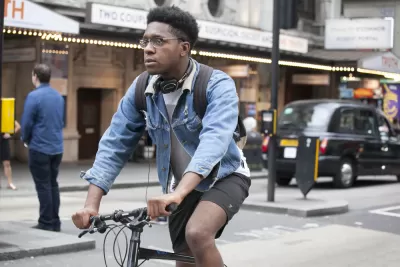
Streetsblog’s Kea Wilson highlights the alarming disparities in cyclist deaths, writing that “Black cyclists are more than four times more likely to die while riding a bike than White ones on a per mile basis, a new study finds — and the stats aren’t much better for other modes or other racially marginalized groups.”
The same study found similar disparities for Black pedestrians, who are 2.2 times more likely to die walking during the day than White pedestrians. This figure swells to 3.4 times more likely after dark. “That’s despite the fact that Black residents logged proportionally fewer miles on foot, bike, or car than most other groups, relative to their share of the population, according to the National Household Travel Survey data from which the stats were sourced.”
Prior to this study, other research suggested that “Black residents are significantly more likely to live on or near dangerous roads with fast vehicle traffic and little lighting, as well as in communities with less investment in transit, protected bike lanes, and well-maintained sidewalks.”
Taken together with his study, [study co-author Matthew Raifman] says these data points signal a clear need for cities to more closely analyze the disparate aspects of traffic violence, not just for the nation as a whole, but in the specific places where Black and Hispanic residents are most likely to travel — especially when it comes time to make life-saving infrastructure investments.
As Wilson writes, “Raifman acknowledges that more research needs to be done to understand the root causes of America’s traffic violence disparities — but that shouldn’t be an excuse for policymakers not to act.”
FULL STORY: Study: Black Cyclists Die 4.5x More Often Than White Cyclists

NYC Bike Deaths Hit 23-Year High
In 2023, 30 people on bikes died on New York City roads.
Is ‘Protected Bike Lane’ an Oxymoron?
Some research suggests that separated and even ‘protected’ bike lanes actually increase the likelihood of car-bike collisions.

Activists Urge Action to Reduce Arizona's Bike and Pedestrian Deaths
The state ranks as the seventh most dangerous for pedestrians, with more than 100 pedestrian and cyclist deaths every year.

Planetizen Federal Action Tracker
A weekly monitor of how Trump’s orders and actions are impacting planners and planning in America.

The state-sanctioned urbicide of Austin
People don’t kill cities. Freeways do.

US to reduce Colorado River water deliveries to Mexico
A new Colorado Treaty amendment reduces Mexico’s Colorado River water allocation by 250,000 acre feet.

5 New England states march closer to 800 megawatt wind energy project
Securing federal approval for the project may be complicated under the Trump administration, which has historically been hostile towards domestic wind power.

Baltimore to break ground on $50 million Transit Priority Project
The project will bring faster bus trips, safer streets and better bike connections to Baltimore.

Airbnb launches $250 million 'last-dollar financing' housing accelerator, makes first investment in Austin
The company will put $6.4 million towards affordable housing development in Texas’ capital.

FREE Course: Walkable City 1: Why Walkability?
After describing his path towards focusing on walkability as the essence of good planning, Jeff Speck marches through his five principal reasons for making more walkable places.
Reinventing Malls: Planning Alchemy—Turning Gray Fields Into Gold
The course focuses on the opportunities and imperatives that shape reinvention of mall sites.

Eagle County Government
Harvard University Graduate School of Design
Nashville Planning Department
The Architects Foundation
University of Cincinnati Online
The Pocatello Development Authority
The Urban Renewal Agency of the City of Pocatello
Journal of the American Planning Association