While the state continues to rely on driving as a primary means of transportation, fighting climate change and the worsening housing crisis means implementing policies that encourage infill development, higher density, and public transit.



Director of the UCLA Institute of Transportation Studies (ITS) Brian Taylor describes results from ITS research analyzing how transportation and housing policies in California can shift to meet the state's climate goals and encourage more sustainable development. "Policies favoring driving over other means of getting around have for decades received little scrutiny, even as many of our metro areas have grown to where traffic congestion is now endemic. It’s no wonder that the transportation sector accounts for more than 40 percent of all of the state’s greenhouse gas emissions, and cars for about three-quarters of that."
"Building primarily around the car consumes a lot of land, costs a lot of money, and generates a lot of emissions," writes Taylor. "Indeed, our diverse panel of interviewed experts mostly called for metropolitan and transportation planning to become more urban-focused and shift to a less sprawling, car-dependent future."
The study highlighted the need for deprioritizing cars, boosting housing density, and improving public transit options in central cities. "Beyond the state’s urban cores, suburbs will need to fill in rather than spread out further into fire-prone areas."
Taylor notes that "Even in small towns and rural areas, new developments should be constructed to make it easier for people to park once and walk to multiple destinations, rather than driving from parking lot to parking lot in developments strung along roadways."
Taylor acknowledges that "old habits die hard" and changing entrenched patterns of urban development won't happen overnight—but today's policy decisions will drive future results.
Read the full story: Don’t let the California Dream become a transportation nightmare


San Diego wants to limit upzoning law to just 16% of transit-adjacent parcels
The city's planning director says some areas are unfit for immediate upzoning due to a lack of resources or hazards such as wildfire risk.
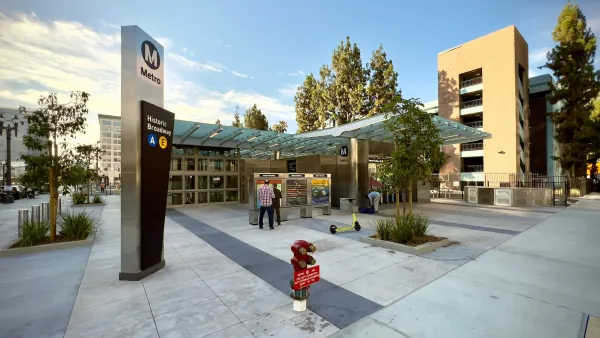
LA Delays State TOD Law to 2030 With its Own, Lower-density Plan
SB 79 allows cities to delay its implementation if they come up with alternate plans to boost density while retaining local control near transit.

House Bill Would Incentivize Housing Near Transit
The Build HUBS Act intends to make federal funding for TOD more available and streamline permitting for transit-adjacent housing.

Planetizen Federal Action Tracker
A weekly monitor of how Trump’s orders and actions are impacting planners and planning in America.

Data reveals that NYC’s bet on congestion pricing has paid off
After almost two years of the program, reports show positive impacts on traffic and air quality and no disruptions to parking.

Denver is solving homelessness. Why aren't the rest of us?
Since 2023, Denver's street homeless population has decreased by 64%, proving that effective tools exist to support those in need of housing.

Will sprawl save California?
California residents will vote on Proposition 45 in November, which would make it easier to build large housing developments on the outskirts of the state’s cities.

Texas suburbs are popping up around old oil wells. Some are starting to leak
Several plugged wells in Texas have failed in recent years, endangering those who unknowingly settled nearby.

This Chicago neighborhood is using planning to increase life expectancy
The Garfield Park Quality-Of-Life Plan aims to bring residents everything from easier access to fresh food to revitalized commercial corridors.

FREE Course: Walkable City 1: Why Walkability?
After describing his path towards focusing on walkability as the essence of good planning, Jeff Speck marches through his five principal reasons for making more walkable places.
Reinventing Malls: Planning Alchemy—Turning Gray Fields Into Gold
The course focuses on the opportunities and imperatives that shape reinvention of mall sites.

Rutgers University, Edward J. Bloustein School of Planning and Public Policy
One Hundred Miles
County of Mendocino
The Architects Foundation
University of Cincinnati Online
Montrose County
Northern Illinois Transit Authority (NITA)
The Pocatello Development Authority