SB 79 allows cities to delay its implementation if they come up with alternate plans to boost density while retaining local control near transit.


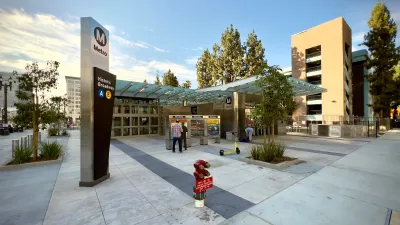
A new California state law requires cities to allow buildings of up to nine stories near transit stations — but cities can opt to delay that requirement until 2030 if they come up with their own version of upzoning, reports Jack Flemming in the Los Angeles Times.
According to Flemming, “On Tuesday, City Council voted to adopt a strategy that would delay the effects of SB 79 city-wide by upzoning 55 single-family and low-density areas, allowing for 4-16 unit buildings up to four stories tall. The 55 areas are mostly located in Central L.A., West L.A., the Eastside and the San Fernando Valley.”
The plan is the least ambitious of three proposals from the Department of City Planning. “The plan adopted Tuesday expands the Opportunity Corridor Transition Area, a provision in the Citywide Housing Incentive Program that incentivizes developers to build small, multi-family housing projects near transit. At the city council meeting, however, critics during public comment pointed out that no housing has actually been built under the provision, so there likely won’t be any built under the newly adopted strategy.”
FULL STORY: Four-story buildings allowed in some single-family zones under L.A.’s plan to delay SB 79

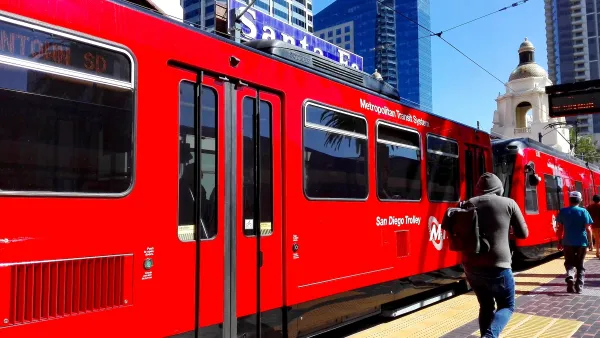
San Diego wants to limit upzoning law to just 16% of transit-adjacent parcels
The city's planning director says some areas are unfit for immediate upzoning due to a lack of resources or hazards such as wildfire risk.
LA Opposes California Bill to add Housing Next to Transit Hubs
In a narrow vote, the city council voted to oppose SB79, a bill that would bypass local zoning laws to allow denser development near transit stops.
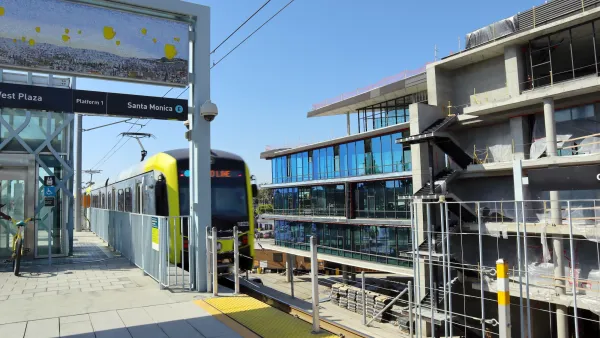
Study: Clarifying California’s Vague Definition of Transit Stops Could Make 1.3M Acres Eligible for Density Bonuses
According to researchers, no California jurisdictions are using the broadest possible definition of a transit stop.

Planetizen Federal Action Tracker
A weekly monitor of how Trump’s orders and actions are impacting planners and planning in America.

The state-sanctioned urbicide of Austin
People don’t kill cities. Freeways do.

US to reduce Colorado River water deliveries to Mexico
A new Colorado Treaty amendment reduces Mexico’s Colorado River water allocation by 250,000 acre feet.

5 New England states march closer to 800 megawatt wind energy project
Securing federal approval for the project may be complicated under the Trump administration, which has historically been hostile towards domestic wind power.

Baltimore to break ground on $50 million Transit Priority Project
The project will bring faster bus trips, safer streets and better bike connections to Baltimore.

Airbnb launches $250 million 'last-dollar financing' housing accelerator, makes first investment in Austin
The company will put $6.4 million towards affordable housing development in Texas’ capital.

FREE Course: Walkable City 1: Why Walkability?
After describing his path towards focusing on walkability as the essence of good planning, Jeff Speck marches through his five principal reasons for making more walkable places.
Reinventing Malls: Planning Alchemy—Turning Gray Fields Into Gold
The course focuses on the opportunities and imperatives that shape reinvention of mall sites.

Eagle County Government
Harvard University Graduate School of Design
Nashville Planning Department
The Architects Foundation
University of Cincinnati Online
The Pocatello Development Authority
The Urban Renewal Agency of the City of Pocatello
Journal of the American Planning Association