The Build HUBS Act intends to make federal funding for TOD more available and streamline permitting for transit-adjacent housing.


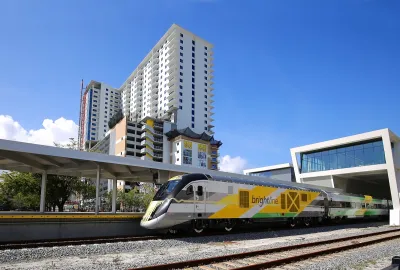
The proposed Build Housing, Unlock Benefits and Services Act, co-sponsored by bipartisan Senators, would prioritize transit-oriented development and make it easier for HUD to support TOD projects, particularly those aimed at low- and middle-income households.
As Julie Strupp explains in Smart Cities Dive, “The bill proposes changes to improve the usability of key infrastructure loan programs that enable HUD and the Department of Transportation to collaborate and prioritize transit-oriented development projects.”
Although the 2021 Infrastructure Investment and Jobs Act amended the Transportation Infrastructure Finance and Innovation Act and the Railroad Rehabilitation and Improvement Financing program to include certain TOD projects, “unforeseen gaps” in authorizations mean projects have not been able to reach their full potential.
The Build HUBS Act would remedy some of the issues by extending TIFIA and RRIF through 2031, clarify the definition of TOD, implement a delegated lending model for TOD projects, and other changes. “The legislation is led in the House of Representatives by Rep. Laura Friedman (D-Calif.) and Rep. Mike Lawler (R-N.Y.). It has been referred to the House Transportation and Infrastructure Committee.”
FULL STORY: Transit-oriented development bill introduced in Congress

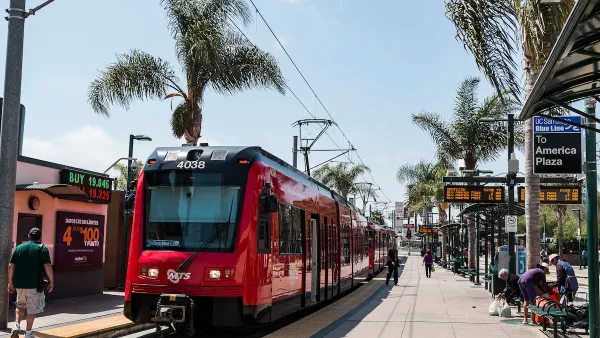
1,000 New Homes Sprouting Around San Diego Trolley Station
Multiple projects, helped along by city and state incentives, will densify the area around the Palm Avenue station.

Report Stresses Links Between Housing and Transit
A Canadian report calls for a more holistic approach to housing development policy and transportation planning.
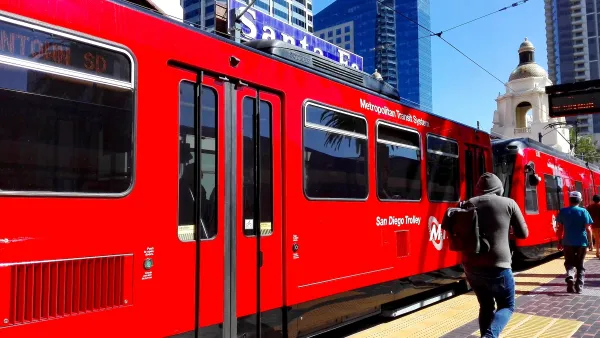
San Diego wants to limit upzoning law to just 16% of transit-adjacent parcels
The city's planning director says some areas are unfit for immediate upzoning due to a lack of resources or hazards such as wildfire risk.

The state-sanctioned urbicide of Austin
People don’t kill cities. Freeways do.

US to reduce Colorado River water deliveries to Mexico
A new Colorado Treaty amendment reduces Mexico’s Colorado River water allocation by 250,000 acre feet.

New Jersey’s second-largest city bans standalone data centers
Jersey City will continue to allow co-location facilities, such as those meant for research institutions that store their own data.

Amtrak not solely to blame for New Jersey commuter rail's unreliability, report finds
A new study from the Garden State Initiative found that NJ Transit’s budget grew 20% across a 4 year period, but reliability declined significantly over the same period.

EPA erases limits on planet-warming pollution from power plants
Under Monday’s plan, power plants would still have some limits on how much mercury, arsenic and other contaminants they can emit.

Phoenix announces new on-demand transit service, more frequent RAPID buses
Both new services will launch in October, and are part of Phoenix's Project Effective Access Solutions for Easing Congestion.

FREE Course: Walkable City 1: Why Walkability?
After describing his path towards focusing on walkability as the essence of good planning, Jeff Speck marches through his five principal reasons for making more walkable places.
Reinventing Malls: Planning Alchemy—Turning Gray Fields Into Gold
The course focuses on the opportunities and imperatives that shape reinvention of mall sites.

Eagle County Government
Harvard University Graduate School of Design
Nashville Planning Department
The Architects Foundation
University of Cincinnati Online
The Pocatello Development Authority
The Urban Renewal Agency of the City of Pocatello
Journal of the American Planning Association