Multiple projects, helped along by city and state incentives, will densify the area around the Palm Avenue station.


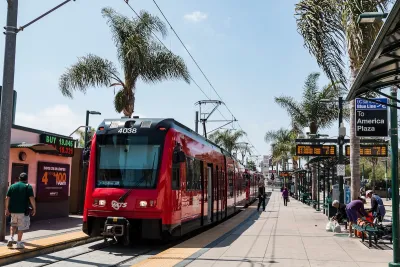
Over 1,000 new housing units will be built near a San Diego transit station thanks to a combination of city incentives, state grants, and a strong demand for more housing in the region, reports David Garrick in The San Diego Union-Tribune.
According to Garrick, “The state awarded the area two grants totaling more than $25 million for new sewer and water lines and infrastructure to make dense development possible there.” The projects are located on the sites of a former go-kart site and an abandoned driving range, requiring new infrastructure for residential use.
The area is served by the San Diego trolley at the Palm Avenue station and a high-frequency bus line. “All of the projects includes resident parking, but the 408-unit project on the trolley parking lot uses some “shared parking” strategies, where some of the homes don’t get an assigned spot.”
Read the full story: More than 1,000 new homes are coming to this South Bay transit stop

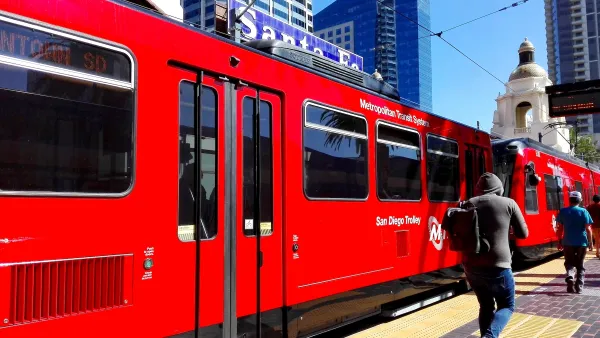
San Diego wants to limit upzoning law to just 16% of transit-adjacent parcels
The city's planning director says some areas are unfit for immediate upzoning due to a lack of resources or hazards such as wildfire risk.
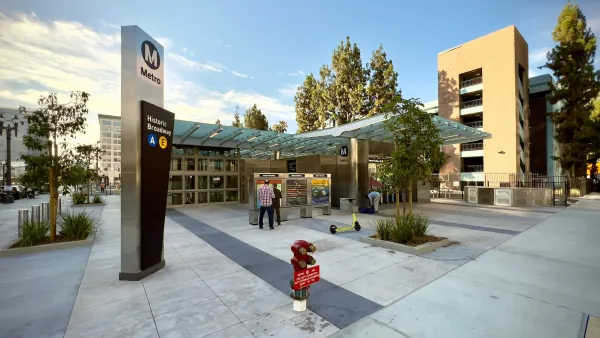
LA Delays State TOD Law to 2030 With its Own, Lower-density Plan
SB 79 allows cities to delay its implementation if they come up with alternate plans to boost density while retaining local control near transit.
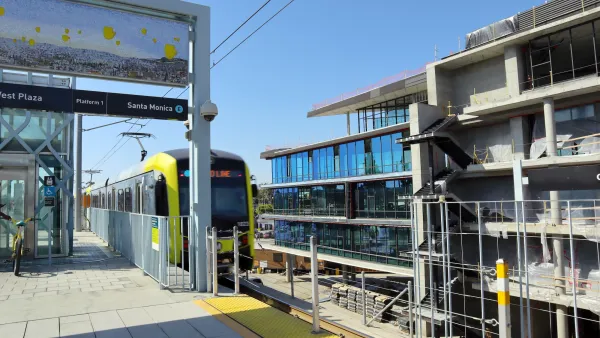
Study: Clarifying California’s Vague Definition of Transit Stops Could Make 1.3M Acres Eligible for Density Bonuses
According to researchers, no California jurisdictions are using the broadest possible definition of a transit stop.

Planetizen Federal Action Tracker
A weekly monitor of how Trump’s orders and actions are impacting planners and planning in America.

California plans to bury El Niño’s downpour
If the state plays its cards right, it may be able to store a billion acre-feet of El Niño’s water in aquifers.

Chicago breaks ground on $3 billion megadevelopment
The new neighborhood, titled Foundry Park, will one day host 3,700 residences.

California High-Speed Rail Authority CEO resigns after $600,000 scandal
Under Ian Choudri, the authority used taxpayer dollars to fund first class flights and trips to nightclubs.

Want to study the Missouri River? Soon, you may need unanimous approval from 10 states
Legislation would require 10 governors’ permission to study or build projects moving water outside the basin.

Desperate measures: Advocates weigh draining Lake Powell to fill Colorado River
Draining the reservoir could reduce evaporation losses by a couple hundred thousand acre-feet.

FREE Course: Walkable City 1: Why Walkability?
After describing his path towards focusing on walkability as the essence of good planning, Jeff Speck marches through his five principal reasons for making more walkable places.
Reinventing Malls: Planning Alchemy—Turning Gray Fields Into Gold
The course focuses on the opportunities and imperatives that shape reinvention of mall sites.

City of Rosemead
Rutgers University, Edward J. Bloustein School of Planning and Public Policy
One Hundred Miles
Hunter College, City University of New York (CUNY)
The Architects Foundation
University of Cincinnati Online
City of Cambridge
Montrose County
The Pocatello Development Authority