Despite a recent designation from the League of American Bicyclists, one writer argues that the city's infrastructure is failing to protect pedestrians and cyclists from dangerous car traffic.


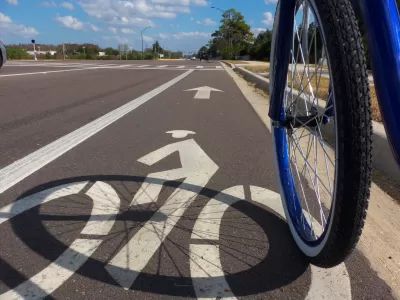
In a guest post for the Gainesville Sun, Emily Hind questions the League of American Bicyclists' recent designation of Gainesville, Florida as a Bicycle Friendly Community at the Silver Level, citing the city's "murderously fast" traffic and three pedestrian deaths to date this year. "In 2021, Florida was rated the worst state in the nation for pedestrian deaths and the second worst for red-light running."
According to Hind, "[t]he problem is not in our individuals, but in our infrastructure." Implementing–not just adopting in name–Vision Zero policies such as reduced speed limits and protected bike lanes would keep pedestrians safe and encourage more people to walk, bike, and use transit. In addition to reducing speed limits to 20mph, Hind suggests redesigning Gainesville streets such as Northwest 16th Avenue "to provide protected space for those who want to walk and roll outside of a car. With less space given to cars, the crosswalks will be less unpredictable, in part because motorists will watch a narrower space for the warning lights, and in part because traffic, given less space, will slow."
"If it’s just about survivability, we all have to be in a car. When we add livable sustainability to our goals, we make Gainesville survivable not just for the moment, but for the children."
Read the full story: Gainesville roads deserve a medal for scares, not shares

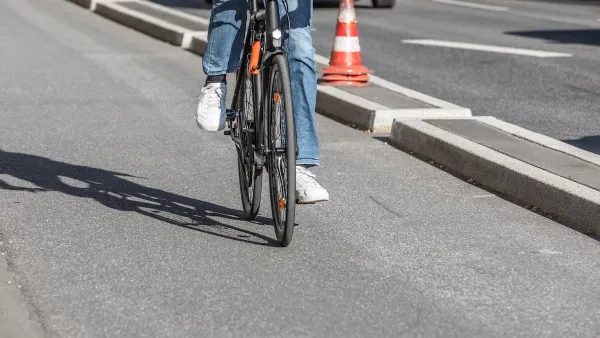
Southeast LA Road Safety Advocates Call for Improved Infrastructure
Streets in southeastern Los Angeles County have a severe lack of protected bike lanes and traffic safety measures, leading to high numbers of fatalities in a community where many residents depend on walking and biking for daily needs.
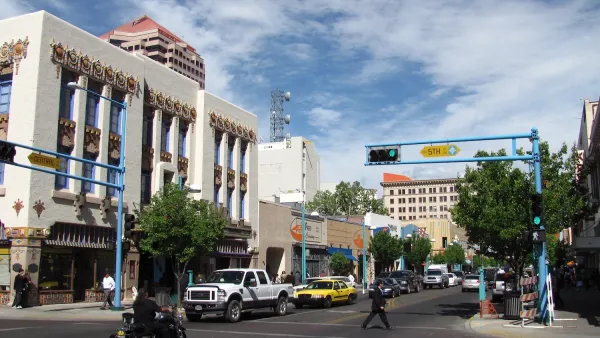
In the Nation’s Deadliest State for Pedestrians, Albuquerque Drivers Must Now Stop at Crosswalks for all Pedestrians
The city updated its traffic code for the first time in 50 years.
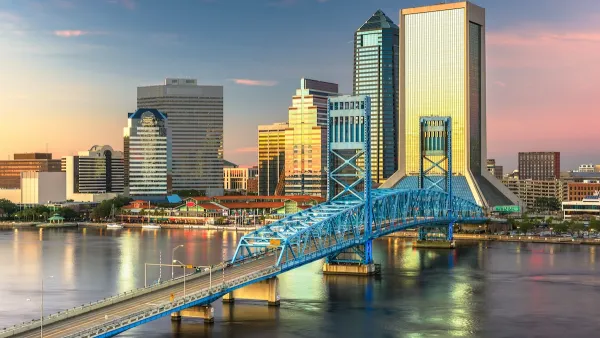
Jacksonville Takes Action on Vision Zero
The city is implementing its first-ever Vision Zero Action Plan in an effort to reduce pedestrian and cyclist deaths and serious injuries.

Planetizen Federal Action Tracker
A weekly monitor of how Trump’s orders and actions are impacting planners and planning in America.

Amtrak, CN end decades-long dispute with eight-year agreement
The new operating agreement establishes an updated framework for the companies to work together, including processes to resolve disputes.

Judges permit Denver to divert 77,000 acre feet from the Colorado River for reservoir expansion
Overuse and climate change have caused the Colorado River’s water levels to plummet.

NYC DOT wants faster, more permanent street upgrades
The city is examining ways to build more concrete infrastructure without getting entangled in 'decades-long' projects.

'Something we’ve never seen before:' rising utility rates could strain city finances nationwide
Data centers, climate change and other factors have caused utility rates in the United States to increase by 38% since 2020.

Trump to overrule local leaders, lease millions of acres of America’s Pacific Island territories’ seafloors to mining companies
International law says that the Indigenous people of America’s territories have a right to prior and informed consent regarding projects that impact their countries.

FREE Course: Walkable City 1: Why Walkability?
After describing his path towards focusing on walkability as the essence of good planning, Jeff Speck marches through his five principal reasons for making more walkable places.
Reinventing Malls: Planning Alchemy—Turning Gray Fields Into Gold
The course focuses on the opportunities and imperatives that shape reinvention of mall sites.

Harvard University Graduate School of Design
KFH Group Inc.
Greater Baltimore Committee
The Architects Foundation
University of Cincinnati Online
The Pocatello Development Authority
The Urban Renewal Agency of the City of Pocatello