The project, which is located near light rail and bus stations, will also include a ride hailing zone, bike parking, and improved pedestrian facilities.


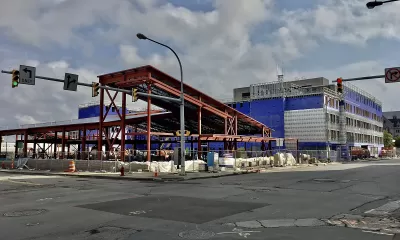
A new housing development in Buffalo will be home to the city's first "mobility hub," designed "to encourage people to walk, bike, take public transit, carshare or any other form of eco-friendly transportation," reports Emily Nanko. "[I]n 2017, Buffalo became the first U.S. city to stop requiring development projects to include a minimum amount of parking. The zoning change also required a 'transportation demand management plan' for new developments over 5,000 square feet."
"A mobility hub made sense not just because residents wanted to prioritize it, but because of the site’s proximity to multiple bus lines and two light rail stations," writes Nanko. "The building design even reflects the needs of the mobility hub. The city expanded the surrounding sidewalks to be more pedestrian friendly and accommodate a 'pull up zone' for ride hailing services. Inside the building there will be secure, long term bicycle parking as well as a fix-it station."
The zoning change seems to have had a significant impact on how developers design their buildings. "A 2021 study analyzing the impact of Buffalo’s 2017 zoning change found that mixed-use developers 'readily took advantage of the newfound possibility to include less off-street parking.' The 14 mixed-use projects tracked provided 53 percent less parking than previously required. Four projects built no parking at all."
Read the full story: Buffalo’s First Mobility Hub Rolls Forward

Fairfax County Considering Bicycle Parking Minimums
Similar to vehicle parking requirements, the proposal would create a tiered system for minimum bike parking spots in new developments.
Burlington Could Eliminate Parking Requirements Citywide
A proposal to eliminate parking minimums in the entire city would also expand Burlington’s Transportation Demand Management program.
North Carolina eliminates parking minimums in most of state
A new state law prevents cities from requiring a certain number of parking spaces for new developments.

Planetizen Federal Action Tracker
A weekly monitor of how Trump’s orders and actions are impacting planners and planning in America.

Amtrak, CN end decades-long dispute with eight-year agreement
The new operating agreement establishes an updated framework for the companies to work together, including processes to resolve disputes.

Nation's most wind-powered state turns to coal as data centers increase energy demand
For the first time in decades, Iowa has increased its generation of coal power.

Alabama scores up to $2.5 billion federal loan for largest infrastructure project in state’s history
The Mobile River Bridge and Bayway Project aims to ease congestion at Alabama’s worst bottleneck.

Trump is considering data centers on 6 states' public land — some state officials say they had no idea
If the administration approves the proposed projects, data center and data center-related developments will cover 17,600 acres of public land.

Despite court ruling, Trump is keeping nearly all wind projects in the US on hold
At least 110 wind energy projects have not heard from the government since a federal judge ruled that the Trump administration's freeze on wind turbine clearances was likely illegal.

FREE Course: Walkable City 1: Why Walkability?
After describing his path towards focusing on walkability as the essence of good planning, Jeff Speck marches through his five principal reasons for making more walkable places.
Reinventing Malls: Planning Alchemy—Turning Gray Fields Into Gold
The course focuses on the opportunities and imperatives that shape reinvention of mall sites.


KFH Group Inc.
Greater Baltimore Committee
Eagle County Government
The Architects Foundation
University of Cincinnati Online
The Pocatello Development Authority
The Urban Renewal Agency of the City of Pocatello