The Metropolitan Atlanta Rapid Transit Authority recently proposed ambitious station design concepts to supplement the Georgia Department of Transportation's plans for a 16-mile express bus lane system on Ga. Highway 400.


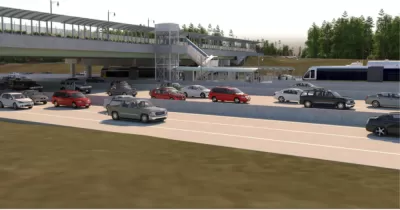
The Metropolitan Atlanta Rapid Transit Authority (MARTA) has revealed new station concepts for proposed express bus lanes on Ga. Highway 400 that would add five stops between Sandy Springs and Alpharetta.
Josh Green reports on the newly released station concepts for the project, cautioning that the bus station concepts still have a long way to go, and funding uncertainties to overcome, before coming to fruition.
"In a perfect world for MARTA," however, "the Georgia Department of Transportation’s express lanes project on Ga. Highway 400 will open in about six years with efficient bus stops in the middle of highway lanes, dotted from Sandy Springs to the northern reaches of Alpharetta, offering transportation alternatives to thousands of commuters daily."
The bus station concepts are meant to supplement the work done by the Georgia Department of Transportation on the express lanes project. As Green explains, "MARTA’s broader goal is to take advantage of the billion-dollar investment GDOT is making to build about 16 miles of express lanes up Ga. Highway 400 as part of the agency’s Major Mobility Investment Program, which will also see express lanes installed on Interstate 285."
In all, "MARTA hopes to build five BRT stations, with stops at North Springs, Holcomb Bridge Road, North Point Mall, Old Milton Parkway, and Windward Parkway in Alpharetta, near Cumming. Total costs could exceed $176 million." MARTA is suggesting that a tax allocation district (TAD) or a special services district (the latter gaining a new example on the BeltLine earlier this month) to come up with the necessary funding to build the stations.
FULL STORY: Concepts emerge for MARTA's rapid bus system up Ga. Highway 400

Atlanta Transit Officials Call for Traffic Cameras to Enforce Bus-Only Lanes
MARTA says bus-mounted cameras would be a more effective way to keep bus lanes clear and make upcoming bus rapid transit lines run smoothly and reliably.
BRT Stations Cut, Project Delayed in Atlanta
Inflation is taking a bite out of planned transportation projects in Georgia. The state's first ever bus rapid transit project provides the latest example of scaled back ambitions.
Light Rail Plans Could Become Bus Rapid Transit Plans in Atlanta
Light rail on the Clifton Corridor was once a centerpiece of a $2.7 billion, 40-year transit expansion plans funded by a voter-approved sales tax. Now MARTA is considering using bus rapid transit on the corridor instead.

The state-sanctioned urbicide of Austin
People don’t kill cities. Freeways do.

US to reduce Colorado River water deliveries to Mexico
A new Colorado Treaty amendment reduces Mexico’s Colorado River water allocation by 250,000 acre feet.

New Jersey’s second-largest city bans standalone data centers
Jersey City will continue to allow co-location facilities, such as those meant for research institutions that store their own data.

Amtrak not solely to blame for New Jersey commuter rail's unreliability, report finds
A new study from the Garden State Initiative found that NJ Transit’s budget grew 20% across a 4 year period, but reliability declined significantly over the same period.

EPA erases limits on planet-warming pollution from power plants
Under Monday’s plan, power plants would still have some limits on how much mercury, arsenic and other contaminants they can emit.

Phoenix announces new on-demand transit service, more frequent RAPID buses
Both new services will launch in October, and are part of Phoenix's Project Effective Access Solutions for Easing Congestion.

FREE Course: Walkable City 1: Why Walkability?
After describing his path towards focusing on walkability as the essence of good planning, Jeff Speck marches through his five principal reasons for making more walkable places.
Reinventing Malls: Planning Alchemy—Turning Gray Fields Into Gold
The course focuses on the opportunities and imperatives that shape reinvention of mall sites.

Eagle County Government
Harvard University Graduate School of Design
Nashville Planning Department
The Architects Foundation
University of Cincinnati Online
The Pocatello Development Authority
The Urban Renewal Agency of the City of Pocatello
Journal of the American Planning Association