The lawsuit over the controversial I-45 project, which has been plagued by local opposition, calls for a new environmental review.


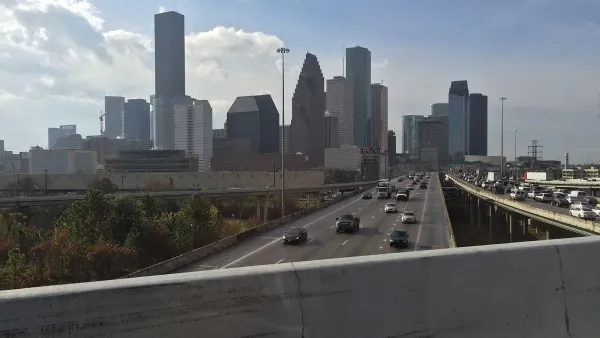
Dug Begley, writing in the Houston Chronicle, continues to provide reporting on the controversial plans for Houston's Interstate 45. Despite the Texas Department of Transportation's recent steps to move forward on the project, local opposition has led to a lawsuit filed by Harris County calling for a halt to the project until a new environmental review can be conducted.
"County officials said TxDOT, even when it did recognize the hundreds of families they will displace and thousands more affected by the wider freeway, did nothing to respond to the county’s aim of staying within the current freeway footprint and developing a solution more in line with improving transit and reconnecting local streets," writes Begley. The county wants state transportation officials to "go back to the drawing board and make sure they are considering these issues."
The project also ran into trouble in March, when "the Federal Highway Administration told TxDOT to 'pause before initiating further contract solicitation,' essentially putting the project’s engineering design on hold as it investigates whether the project properly followed civil rights-era rules for displacing residents."
After a decade and a half of planning, the project still fails to meet the expectations of many residents and community groups. Oni Blair, executive director of LINKHouston, an organization that opposes the proposed design, says advocates want to see a revised plan that "prioritizes the people who live along the highway" and "avoids assumptions that wider or faster is better" when it comes to freeway redevelopment.
Additional coverage on the lawsuit is available from Paul Debenedetoo for Houston Public Media and Juan A. Lozano for the Associated Press.
FULL STORY: Harris County sues to stop I-45 rebuild plans by TxDOT

Contentious Houston Freeway Widening Project Inches Forward
Federal officials have given TxDOT the go-ahead to resume work on a small portion of a controversial interstate widening project in downtown Houston.

Halted Interstate Expansion Could Proceed in Houston
Local and state officials have come to an ‘historic’ agreement that could move the stalled project forward.

Proposed Park Yet Another Hurdle for Houston Interstate Expansion
The Interstate 45 widening project, halted by a federal order and opposed by many local officials and organizations, could hit a new snag if White Oak Bayou becomes a city park.

The state-sanctioned urbicide of Austin
People don’t kill cities. Freeways do.

US to reduce Colorado River water deliveries to Mexico
A new Colorado Treaty amendment reduces Mexico’s Colorado River water allocation by 250,000 acre feet.

New Jersey’s second-largest city bans standalone data centers
Jersey City will continue to allow co-location facilities, such as those meant for research institutions that store their own data.

Amtrak not solely to blame for New Jersey commuter rail's unreliability, report finds
A new study from the Garden State Initiative found that NJ Transit’s budget grew 20% across a 4 year period, but reliability declined significantly over the same period.

EPA erases limits on planet-warming pollution from power plants
Under Monday’s plan, power plants would still have some limits on how much mercury, arsenic and other contaminants they can emit.

Phoenix announces new on-demand transit service, more frequent RAPID buses
Both new services will launch in October, and are part of Phoenix's Project Effective Access Solutions for Easing Congestion.

FREE Course: Walkable City 1: Why Walkability?
After describing his path towards focusing on walkability as the essence of good planning, Jeff Speck marches through his five principal reasons for making more walkable places.
Reinventing Malls: Planning Alchemy—Turning Gray Fields Into Gold
The course focuses on the opportunities and imperatives that shape reinvention of mall sites.

_from_the_ramp_between_westbound_Interstate_10_and_southbound_Interstate_45_in_Houston,_Harris_County,_Texas.jpg)
Eagle County Government
Harvard University Graduate School of Design
Nashville Planning Department
The Architects Foundation
University of Cincinnati Online
The Pocatello Development Authority
The Urban Renewal Agency of the City of Pocatello
Journal of the American Planning Association