The day after Election Day in America, the U.K. Parliament voted overwhelmingly to impose a 4-week lockdown in England to ensure that nation's prized healthcare system doesn't collapse due to treating mounting coronavirus infections.


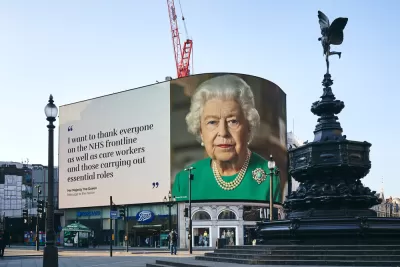
The day before Americans cast their votes for the next president, the prime minister of the United Kingdom explained to the Members of Parliament (MPs) the importance of the vote they would cast on Wednesday.
"The UK faces a 'medical and moral disaster' unless tough action is taken now to stop the spread of coronavirus, Prime Minister Boris Johnson has said," reported the BBC on Nov. 2.
He told MPs there was "no alternative" but to introduce a national lockdown - which is due to begin on Thursday - to prevent the NHS from being overwhelmed.
The MPs approved the plan, which applies only to England (see below for coronavirus restrictions applicable to the other three U.K. nations), by 516 votes to 38, report Jon Stone and Andrew Woodcock for The Independent on Nov. 4. "The vote came after a stormy debate in which a succession of Conservative backbenchers voiced opposition to the new restrictions, which will force the closure of pubs, restaurants and non-essential shops and require people to stay home as much as possible."
What's rather remarkable to this observer from across the pond is that the political debate over imposing coronavirus mitigations and their negative impact on the economy and civil liberties is not that dissimilar from what we are seeing in the U.S., though it is happening at a more centralized level. Objection to the lockdown came from Prime Minister Johnson's own Conservative Party, also referred to as Tory MPs in the source article, including his predecessor, Theresa May.
"The government today making it illegal to conduct an act of public worship for the best of intentions, sets a precedent that could be misused for a government in the future with the worst of intentions," Ms May warned.
See this BBC compilation of the new lockdown rules for England that began Nov. 5 and end Dec. 2, and:
- Scotland's new five-tier system of coronavirus restrictions
- The existing temporary lockdown rules in place in Wales, Scotland and Northern Ireland
The opposition Labour Party was critical of Johnson, a coronavirus survivor, for acting too late and potentially ending the restrictions too early.
Labour leader Keir Starmer had harsh words for the prime minister, despite ordering his MPs to support the government in the vote. Rounding on the government’s exit strategy for the lockdown, Sir Keir said it would be “madness” for England to leave lockdown on 2 December if coronavirus rates are still rising.
“We have got to look the public in the eye,” Sir Keir told the prime minister at PMQs ahead of the debate. “If the infection rate is still going up on 2 December, it is madness to come back to the tier system. We know the one thing the tier system can't cope with is an R rate above one.”
The U.S. sets coronavirus record, but voters more focused on the economy
Meanwhile, on this side of the pond on Election Day, "exit polls showed that voters were more concerned about the state of the economy than public health," notes The Washington Post's "coronavirus updates" for Nov. 4, a day which marked the first time any nation has logged over 100,000 coronavirus infections in a 24-hour period.
The record, 104,004 cases, was reached a day after the deeply divided nation went to the polls to choose between President Trump and Democratic nominee Joe Biden, an election widely seen as a choice between fully reopening the economy and aggressively quelling the outbreak.
According to data collected by Edison Research, a consortium of television networks, "about 4 in 10 voters said they would prioritize the economy over efforts to limit the spread of the coronavirus," report Lenny Bernstein and Joel Achenbach in the Post article referenced in the update.
Around one-third of voters said they were primarily motivated by the economy...
About 2 in 10 voters said the pandemic that has left more than 232,000 Americans dead and upended life around the globe was the most important issue on their minds as they selected a president and other officials to lead the United States out of its more than nine-month public health crisis.
About the same number cited racial inequality.
Why the U.S. should be concerned with the European coronavirus resurgence
As bad as the coronavirus outbreak is in the U.S., particularly in the Midwest and Mountain States, it's worse in Europe. Average daily infections in the U.S. are 27 per 100,000 people and 36 per 100k in Europe on Nov. 5 according to The Washington Post
Public health experts have warned that the U.S. trajectory is on the epidemic curve as Europe; we're just behind them chronologically in the way that the New York City outbreak in late March followed the crisis in Northern Italy in early March.
“We’re about maybe three weeks behind Europe, maybe a month at the most, so we’re on the trajectory to look a lot like Europe as we enter the month of November,” Dr. Scott Gottlieb, a former FDA commissioner, told CNBC’s “Squawk Box” [Oct. 28]. “So I think things are going to get worse.”
Related in Planetizen:
- 'We are Entering the Steep Slope of the Epidemic Curve', Nov. 1, 2020
- Learning from Down Under, July 15, 2020
- Suppression or Mitigation? The Language of Coronavirus Containment [more on U.K.'s first 'virtual lockdown'], March 31, 2020
- Britain Shuts Down and India Locks Down to Contain COVID-19, March 26, 2020
-
A Nation of 60 Million on Lockdown, March 11, 2020
FULL STORY: England to go into lockdown from midnight tonight after MPs approve new restrictions

The Pandemic Is Not Ending—But Restrictions Are
The science hasn't changed but the politics have, and policymakers are responding appropriately. Transmission of the coronavirus during the Omicron wave remains at an all-time high, although infections are decreasing globally.

Germany Locks Down to Protect Healthcare System
Beginning Dec. 16, all of Germany will be subject to stricter coronavirus restrictions to reduce infections following a meeting with the chancellor and the 16 state governors. Schools will close and restaurants will be confined to take-out service.

El Paso Update: 'On the Brink of Disaster'
Among the nation's more populous counties, El Paso continues to suffer the most severe coronavirus outbreak. One out of nearly every 30 residents currently has COVID-19. Four additional mobile morgues, on top of the existing six, have been ordered.

The state-sanctioned urbicide of Austin
People don’t kill cities. Freeways do.

US to reduce Colorado River water deliveries to Mexico
A new Colorado Treaty amendment reduces Mexico’s Colorado River water allocation by 250,000 acre feet.

New Jersey’s second-largest city bans standalone data centers
Jersey City will continue to allow co-location facilities, such as those meant for research institutions that store their own data.

Amtrak not solely to blame for New Jersey commuter rail's unreliability, report finds
A new study from the Garden State Initiative found that NJ Transit’s budget grew 20% across a 4 year period, but reliability declined significantly over the same period.

EPA erases limits on planet-warming pollution from power plants
Under Monday’s plan, power plants would still have some limits on how much mercury, arsenic and other contaminants they can emit.

Phoenix announces new on-demand transit service, more frequent RAPID buses
Both new services will launch in October, and are part of Phoenix's Project Effective Access Solutions for Easing Congestion.

FREE Course: Walkable City 1: Why Walkability?
After describing his path towards focusing on walkability as the essence of good planning, Jeff Speck marches through his five principal reasons for making more walkable places.
Reinventing Malls: Planning Alchemy—Turning Gray Fields Into Gold
The course focuses on the opportunities and imperatives that shape reinvention of mall sites.

Eagle County Government
Harvard University Graduate School of Design
Nashville Planning Department
The Architects Foundation
University of Cincinnati Online
The Pocatello Development Authority
The Urban Renewal Agency of the City of Pocatello
Journal of the American Planning Association