In a major reversal, Prime Minister Boris Johnson dramatically strengthened his policies on containing the pandemic, ordering residents on Monday to stay at home and closing nonessential businesses. Prime Minister Narendra Modi of Inda went further.



"Facing a growing storm of criticism about his laissez-faire response to the fast-spreading coronavirus, Prime Minister Boris Johnson announced on Monday that he would place Britain under a virtual lockdown, closing all nonessential shops, banning meetings of more than two people, and requiring people to stay in their homes, except for trips for food or medicine," report Mark Landler and
The restrictions, though enforceable, don't require people who leave their homes to carry documents, the key distinction between a shutdown (of nonessential services) and a "lockdown" like Prime Minister Giuseppe Conte did in Italy on March 10.
The measures took effect immediately on March 23. "We will look again in three weeks, and relax them if the evidence shows we are able to," stated Johnson.
India
"In a speech Tuesday night, Indian Prime Minister Narendra Modi made clear that the country was at a crucial juncture," report Joanna Slater and for The Washington Post. “If we don’t manage these 21 days, the country will be set back by 21 years,” he said.
His emotional appeal to citizens not to step out of their homes did not include specifics about how they would meet basic needs. That immediately provoked frantic buying at grocery stores, which remain open as essential services.
Less than an hour after his speech, Modi wrote in a tweet that there was no need for panic and that authorities would ensure access to food and medicine.
In the prime minister's announcement, he noted "that even those nations with the best of the medical facilities could not contain the virus and that the social distancing is the only option to mitigate it."
The three-week lockdown, which took effect Tuesday at midnight, stopped all train and bus service serving the nation of 1.3 billion. The lockdown was praised by Michael Ryan, executive director of the World Health Organization’s health emergencies program.
"Large, densely populated countries such as India will determine “the future of this pandemic," said Ryan (see video.) He noted the historic roles the country led in eradicating smallpox and the effort to eliminate polio.
"It's really important that India continues to take aggressive action at the public health level and at the level of society to contain, control, supress this disease and to save lives."
"There are no silver bullets here. There are no easy answers...These are measures we can take now while we wait for other solutions, and we must taken them now."
Related in Planetizen:
-
A Nation of 60 Million on Lockdown, March 11, 2020
FULL STORY: Britain Placed Under a Virtual Lockdown by Boris Johnson


Academic Studies: Staying at Home Saved Millions of Lives Globally
Separate coronavirus studies from the University of California at Berkeley and Imperial College London published June 8 in the journal Nature show the life and health-saving value of domestic stay-at-home orders, global lockdowns, and other measures.
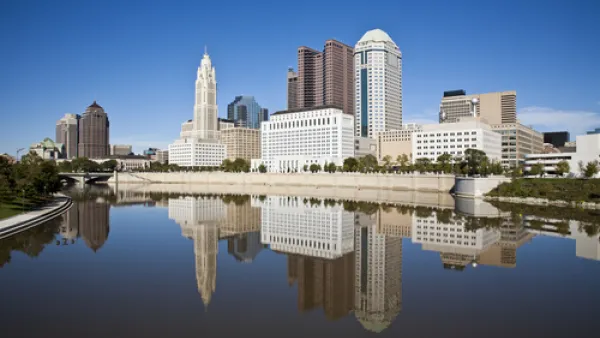
Another State (Ohio) Gets It Right
Washington and California have been praised for early efforts to mitigate community spread of the novel coronavirus, resulting in relatively low rates of infection, hospitalization, and ultimately, death. Add Ohio to the bunch.
Suppression or Mitigation? The Language of Coronavirus Containment
A report from Imperial College London, viewed as the "gold standard" by British leaders, was instrumental in compelling the U.S. and the U.K. to enact stronger policies to contain COVID-19. But was it too late?

Planetizen Federal Action Tracker
A weekly monitor of how Trump’s orders and actions are impacting planners and planning in America.

The state-sanctioned urbicide of Austin
People don’t kill cities. Freeways do.

US to reduce Colorado River water deliveries to Mexico
A new Colorado Treaty amendment reduces Mexico’s Colorado River water allocation by 250,000 acre feet.

Airbnb launches $250 million 'last-dollar financing' housing accelerator, makes first investment in Austin
The company will put $6.4 million towards affordable housing development in Texas’ capital.

Guerilla urbanists are building DIY bus stop benches in Chicago
A before-and-after of one of the bus stops with a new bench. The new benches are not officially sanctioned or permitted, but the residents who placed them hope they will be the start of a network of DIY benches across the city.

Mamdani overhauls NYC's Vision Zero plan with 100 new policy goals
The overhaul aims to reduce traffic deaths and make streets safer for pedestrians, cyclists and drivers through lower speed limits, new safety infrastructure and more.

FREE Course: Walkable City 1: Why Walkability?
After describing his path towards focusing on walkability as the essence of good planning, Jeff Speck marches through his five principal reasons for making more walkable places.
Reinventing Malls: Planning Alchemy—Turning Gray Fields Into Gold
The course focuses on the opportunities and imperatives that shape reinvention of mall sites.

Eagle County Government
Harvard University Graduate School of Design
Nashville Planning Department
The Architects Foundation
University of Cincinnati Online
The Pocatello Development Authority
The Urban Renewal Agency of the City of Pocatello
Journal of the American Planning Association