New York City is appealing a judge's decision to toss the Inwood NYC Action Plan, approved by the city in 2018. Next City describes the racial justice implications of the court case and the plan.


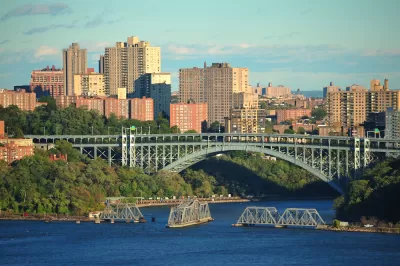
"Black, indigenous and other people of color are fighting back against generations of structural violence waged against them based on race," writes Oscar Perry Abello.
The racial equity conversation in recent weeks has turned to matters of land use, as the discriminatory history of exclusionary zoning and car-centric planning has faced another round of criticism as tools of systemic racism. Abello reports on the ongoing legal controversy over the Inwood NYC Action Plan, approved in 2018, which serves as a reminder that ostensibly progressive zoning reform isn't necessarily a victory for racial and social justice:
They’re also fighting back in the New York State Appellate Division court, which last week heard oral arguments in a case where residents of the heavily Dominican immigrant Inwood neighborhood filed a lawsuit charging that the city should have followed their demand for a racial impact analysis before rezoning 240 acres of the neighborhood. The rezoning would allow developers to demolish existing residential, commercial and mixed-use buildings and replace them with even larger buildings, containing 4,348 additional housing units, about a third of which would be income-restricted, as well as adding 1.1 million square feet of commercial space to the neighborhood.
The city is appealing a previous court decision that overthrew the plan, which Crain's New York Business covered without mentioning the demand for a racial impact analysis. An article published by City Limits, however, noted the lack of demographic considerations undertaken by the environmental review for the plan.
Cheryl Pahaham—a longtime Inwood resident, a member of Northern Manhattan is Not for Sale, and co-defendant in the lawsuit seeking to overturn the plan—is quoted in the article saying that the complaints about the Inwood NYC Action Plan focus on process. If that's the case, the city has a long way to go, and not just in Inwood, to make amends. Abello cites a study by Elena Conte, deputy director of the Pratt Center for Community Development, that examined 14 different neighborhood-level rezonings approved in New York City from 2004 to 2019. "Conte found there was not a single instance where the city determined there would be any significant 'adverse environmental impact' from commercial displacement," according to Abello.
FULL STORY: Rezoning by the Book, When the Book Ignores Race

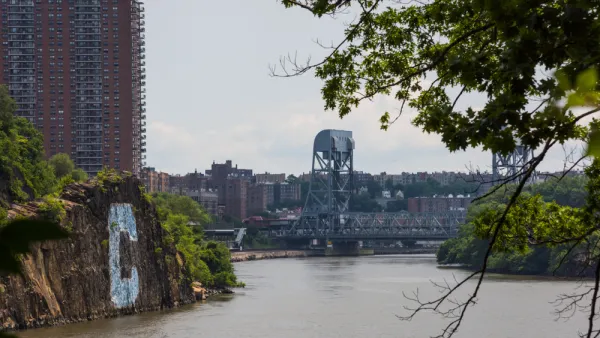
A New Generation of Community-Led Planning in New York
With a benchmark success in demanding rights for the community during an ongoing rezoning process in Inwood, a neighborhood in Manhattan, a new generation of community-led resistance to top-down planning is coalescing in New York City.
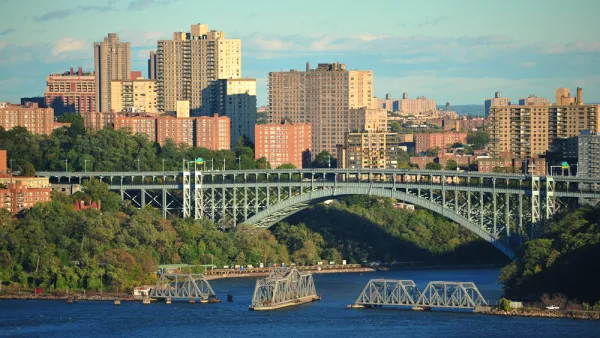
NYC Rezoning Plan Reinstated Despite Lack of Racial Impact Analysis
The New York Appellate Division's First Department made short work of a ruling that reinstated the Inwood NYC Action Plan, which a lower court dismissed in December 2019.
Judge Tosses Manhattan Rezoning; Developer Tosses Affordable Housing Project
A court decision to toss a signature rezoning plan of the de Blasio administration in New York City had immediate repercussions for a development proposal that would have added hundreds of new affordable housing units.

Planetizen Federal Action Tracker
A weekly monitor of how Trump’s orders and actions are impacting planners and planning in America.

The state-sanctioned urbicide of Austin
People don’t kill cities. Freeways do.

US to reduce Colorado River water deliveries to Mexico
A new Colorado Treaty amendment reduces Mexico’s Colorado River water allocation by 250,000 acre feet.

Baltimore to break ground on $50 million Transit Priority Project
The project will bring faster bus trips, safer streets and better bike connections to Baltimore.

Airbnb launches $250 million 'last-dollar financing' housing accelerator, makes first investment in Austin
The company will put $6.4 million towards affordable housing development in Texas’ capital.

Guerilla urbanists are building DIY bus stop benches in Chicago
A before-and-after of one of the bus stops with a new bench. The new benches are not officially sanctioned or permitted, but the residents who placed them hope they will be the start of a network of DIY benches across the city.

FREE Course: Walkable City 1: Why Walkability?
After describing his path towards focusing on walkability as the essence of good planning, Jeff Speck marches through his five principal reasons for making more walkable places.
Reinventing Malls: Planning Alchemy—Turning Gray Fields Into Gold
The course focuses on the opportunities and imperatives that shape reinvention of mall sites.

Eagle County Government
Harvard University Graduate School of Design
Nashville Planning Department
The Architects Foundation
University of Cincinnati Online
The Pocatello Development Authority
The Urban Renewal Agency of the City of Pocatello
Journal of the American Planning Association