With a benchmark success in demanding rights for the community during an ongoing rezoning process in Inwood, a neighborhood in Manhattan, a new generation of community-led resistance to top-down planning is coalescing in New York City.


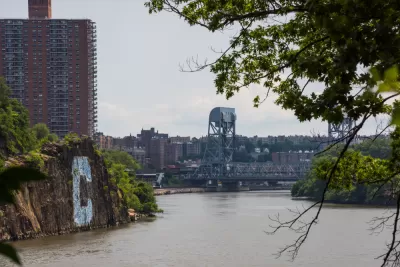
Oscar Perry Abello's examination of the ongoing community-led opposition to a proposed rezoning in the Inwood neighborhood in Manhattan starts in July 2018, at the "Block Party for a Just Rezoning," organized by Northern Manhattan Is Not For Sale, an all-volunteer coalition of Inwood residents and business owners.
"The organizers hoped to use the occasion to pressure their local council member to nix a city-driven rezoning plan and instead follow an alternative the coalition had proposed," according to Abello. That hope has given way to an ongoing political battle, and a recent legal win, after a judge ruled that the city had failed to consider the racial impact of zoning changes, and sent the plan back to the drawing table.
Abello, who covered the court decision in June for Next City, is writing this story for a new publication with a little more space to examine the Inwood story and other examples of immigrant communities starting to "win major victories against developers and even City Hall, pushing back against changes that they fear would result in the loss of their neighborhoods."
As a first step, as detailed in the article, is the challenge of translating the jargon and minutiae of planning to largely immigrant communities. For examples of that work, Abello explores beyond Inwood, citing the work of Queens Neighborhoods United as an example.
FULL STORY: Reclaiming Neighborhood Power


Lack of Racial Impact Analysis Opens Inwood Plan to Legal Challenge in New York City
New York City is appealing a judge's decision to toss the Inwood NYC Action Plan, approved by the city in 2018. Next City describes the racial justice implications of the court case and the plan.
NYC Rezoning Plan Reinstated Despite Lack of Racial Impact Analysis
The New York Appellate Division's First Department made short work of a ruling that reinstated the Inwood NYC Action Plan, which a lower court dismissed in December 2019.
Judge Tosses Manhattan Rezoning; Developer Tosses Affordable Housing Project
A court decision to toss a signature rezoning plan of the de Blasio administration in New York City had immediate repercussions for a development proposal that would have added hundreds of new affordable housing units.

The state-sanctioned urbicide of Austin
People don’t kill cities. Freeways do.

US to reduce Colorado River water deliveries to Mexico
A new Colorado Treaty amendment reduces Mexico’s Colorado River water allocation by 250,000 acre feet.

New Jersey’s second-largest city bans standalone data centers
Jersey City will continue to allow co-location facilities, such as those meant for research institutions that store their own data.

Amtrak not solely to blame for New Jersey commuter rail's unreliability, report finds
A new study from the Garden State Initiative found that NJ Transit’s budget grew 20% across a 4 year period, but reliability declined significantly over the same period.

EPA erases limits on planet-warming pollution from power plants
Under Monday’s plan, power plants would still have some limits on how much mercury, arsenic and other contaminants they can emit.

Phoenix announces new on-demand transit service, more frequent RAPID buses
Both new services will launch in October, and are part of Phoenix's Project Effective Access Solutions for Easing Congestion.

FREE Course: Walkable City 1: Why Walkability?
After describing his path towards focusing on walkability as the essence of good planning, Jeff Speck marches through his five principal reasons for making more walkable places.
Reinventing Malls: Planning Alchemy—Turning Gray Fields Into Gold
The course focuses on the opportunities and imperatives that shape reinvention of mall sites.

Eagle County Government
Harvard University Graduate School of Design
Nashville Planning Department
The Architects Foundation
University of Cincinnati Online
The Pocatello Development Authority
The Urban Renewal Agency of the City of Pocatello
Journal of the American Planning Association