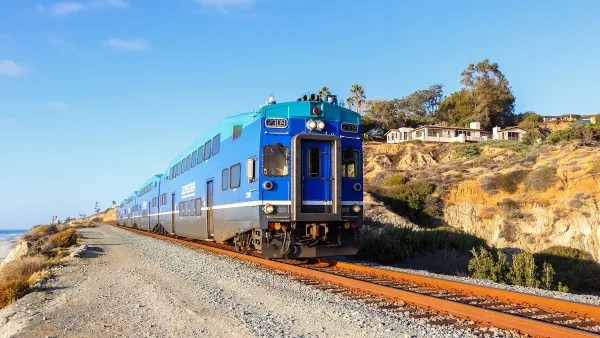
The Amtrak route between Los Angeles, San Diego, and San Luis Obispo is one of the projects to receive a boost from the California State Transportation Agency's 2020 Transit and Intercity Rail Capital Program (TIRCP).


"The Los Angeles–San Diego–San Luis Obispo (LOSSAN) passenger-rail corridor agency yesterday was awarded a $38.7 million state grant to improve Amtrak’s Pacific Surfliner service in Southern California," according to an article in Progressive Railroading.
"The state grant to LOSSAN includes funding to help overhaul and modernize rail cars on the Pacific Surfliner service and build two train layover facilities in San Luis Obispo County and San Diego, LOSSAN agency officials said in a press release."
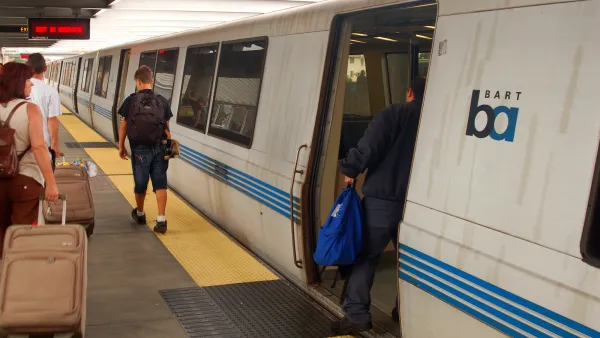
The 2020 of funding for California's Transit and Intercity Rail Capital Program (TIRCP) is providing $500 million to transportation projects designed to reduce greenhouse gas emissions, includign the $38.7 million for the Pacific Surfliner. A separate article in Mass Transit magazine provides information about the rest of the money awarded under the TIRCP in its 2020 cycle of funding. Seventeen recipients in all will receive funding in 2020. The largest award, $107.1 million, went to Bay Area Rapid Transit (BART) for rail vehicle acquisition for the Transbay Corridor Core Capacity Program. An additional humber of BART cars will allow rail service through the Transbay tube "to increase from 23 to 30 trains per hour in each direction, as well as the operation of 10-car trains on all service in peak hours."
Funding for the TIRCP was created by the Road Repair and Accountability Act of 2017 (SB 1) and from the Cap and Trade program proceeds, according to Mass Transit.
Read the full story: California awards $500 million in transit and rail project grants
BART Service Cuts, Station Closures Could ‘Set Back the System 50 Years’
The agency could close dozens of stations and eliminate the Blue line between Daly City and Dublin-Pleasanton entirely.

BART Closes $35 Million Deficit
Cost control and revenue generation measures prevented service cuts.
SoCal Leaders Debate Moving Coastal Rail Line
Train tracks running along the Pacific Ocean are in danger from sea level rise, but residents are divided on how to fix the problem.

Desperate measures: Advocates weigh draining Lake Powell to fill Colorado River
Draining the reservoir could reduce evaporation losses by a couple hundred thousand acre-feet.

Eastern Nebraska is running out of electricity
Data centers and electrification are straining eastern Nebraska’s grid, throttling economic development.

Move over, LA: St. Louis gears up for Olympics, invests millions in downtown redevelopment
The Missouri city will host the 2028 Olympic soccer group stage and knockout matches.

Mass. votes against statewide minimum lot size for single-family homes
Over 2 million residents voted on Question 7; it was decided by just over 30,000 votes.

Maryland’s $15 billion bridge project gains key approval
The Maryland Transit Authority said the project will create over 60,000 jobs and add $23 billion to the local economy.

‘No clear next steps’ for Chicago's permanent festival grounds
Eleventh Ward Ald. Nicole Lee has suggested Soldier Field as a possible location for the permanent event space.

FREE Course: Walkable City 1: Why Walkability?
After describing his path towards focusing on walkability as the essence of good planning, Jeff Speck marches through his five principal reasons for making more walkable places.
Reinventing Malls: Planning Alchemy—Turning Gray Fields Into Gold
The course focuses on the opportunities and imperatives that shape reinvention of mall sites.


City of Rosemead
Rutgers University, Edward J. Bloustein School of Planning and Public Policy
One Hundred Miles
University of Michigan School for Environment and Sustainability (SEAS)
Hunter College, City University of New York (CUNY)
The Architects Foundation
City of Cambridge
The Pocatello Development Authority
The Urban Renewal Agency of the City of Pocatello