Congressional Democrats hope transportation infrastructure can be a winning political point during a campaign year following the impeachment of President Donald Trump.


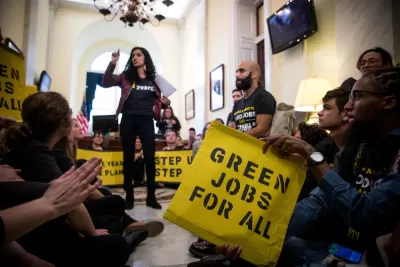
"House Democrats on Wednesday unveiled a $760 billion framework to fund infrastructure investments over five years in an effort to take their first steps on a top campaign priority," reports Cristina Marcos.
The framework falls short of a legislative action, according to Marcos, but the proposal is intended to set a "marker for a top legislative priority for the 2020 campaign…." Details remaining to work out, for instance, include how to fund the investments targeted in the framework.
"The Democrats' framework proposes $329 billion for roads and bridges, $55 billion for passenger rail, $30 billion for airport investments, $50.5 billion for wastewater infrastructure, $86 billion for expanding broadband access for rural areas, and $12 billion for a "next-generation" 911 system for emergency calls," according to Marcos.
A separate article by Tanya Snyder highlights the climate theme found in the proposal: House Transportation Chairman Peter DeFazio (D-Ore.) says the plan will be a radical departure from highway-focused transportation bills and will put clean energy and climate 'resilience' at the center."
"The climate plan, according to DeFazio, will include everything from making federal buildings carbon-neutral to transitioning to renewable fuels for aviation. He also wants to improve rail and transit options 'as a more efficient way to move passengers than short-haul airlines and automobiles' and use more climate-friendly building materials, like concrete with coal ash that 'actually absorbs carbon.'"
Snyder also contrasts this effort by Democrats to set a tone for the campaign to a five-year transportation bill reauthorization already working its way through the U.S. Senate. That bill mentions climate in the title—a first for a transportation bill reauthorization.
FULL STORY: House Democrats unveil $760B infrastructure plan

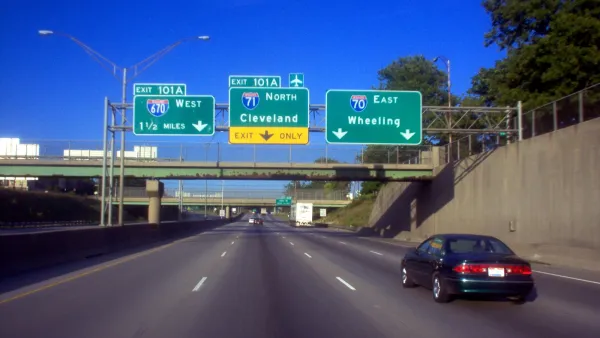
The 'INVEST in America Act' Would Help States Kick the Highway Habit
While Congress debates its bipartisan infrastructure deal, a House-approved bill, the INVEST in America Act, waits in the wings with the potential to alter the direction of transportation planning in the United States.
Planning Trends for 2025: Creative Housing Solutions, Ongoing Transit Woes, and the Ever-Creeping Tentacles of AI
Urban planners have no shortage of urgent issues to delve into, from a deepening housing crisis to an increasingly unpredictable climate to a new federal administration bent on slashing key funding for everything from electric cars to housing assistance.
California Environmental Leaders Call on State Agencies to Prioritize Multimodal Transportation
Even before President Trump took office, California was not meeting its emissions reduction goals.

The state-sanctioned urbicide of Austin
People don’t kill cities. Freeways do.

US to reduce Colorado River water deliveries to Mexico
A new Colorado Treaty amendment reduces Mexico’s Colorado River water allocation by 250,000 acre feet.

New Jersey’s second-largest city bans standalone data centers
Jersey City will continue to allow co-location facilities, such as those meant for research institutions that store their own data.

Amtrak not solely to blame for New Jersey commuter rail's unreliability, report finds
A new study from the Garden State Initiative found that NJ Transit’s budget grew 20% across a 4 year period, but reliability declined significantly over the same period.

EPA erases limits on planet-warming pollution from power plants
Under Monday’s plan, power plants would still have some limits on how much mercury, arsenic and other contaminants they can emit.

Phoenix announces new on-demand transit service, more frequent RAPID buses
Both new services will launch in October, and are part of Phoenix's Project Effective Access Solutions for Easing Congestion.

FREE Course: Walkable City 1: Why Walkability?
After describing his path towards focusing on walkability as the essence of good planning, Jeff Speck marches through his five principal reasons for making more walkable places.
Reinventing Malls: Planning Alchemy—Turning Gray Fields Into Gold
The course focuses on the opportunities and imperatives that shape reinvention of mall sites.

Eagle County Government
Harvard University Graduate School of Design
Nashville Planning Department
The Architects Foundation
University of Cincinnati Online
The Pocatello Development Authority
The Urban Renewal Agency of the City of Pocatello
Journal of the American Planning Association