Car dependence will have to end for the most ambitious climate plans put forward by Democratic candidates for president to have the desired effect.


Bernie Sanders, senator from Vermont and Democratic presidential candidate, devotes an entire section of a new climate plan to transportation, calling for total decarbonization of the transportation sector by 2030. But it's not enough, according to an article by Alissa Walker.
The problem, according to Walker, is in the plan's car-centric nature.
Sanders’s plan is still almost all about cars, even if they are electric. His proposals won’t erase commutes and congestion. And more livable, connected, and vibrant communities certainly won’t be created by offering incentives to buy plug-in vehicles and building more places to plug them in. This plan to comprehensively electrify America’s cars will use up almost one-fifth of the entire Green New Deal budget, more than what’s allotted to build a nationwide renewable energy grid and storage system—and much of that capacity would go toward powering all the EVs.
In effect, Walker is calling for progressive transportation policy to move beyond tackling fossil fuel dependence to also tackle car dependence.
FULL STORY: Only one candidate is talking seriously about transportation. Everyone should be


Town Hall Spotlights Democrats' Climate Change Proposals
Critics of the earliest Democratic candidate debates have noted a conspicuous lack of substantive and concentrated discussion on one of the great existential threats of the era: climate change. Neglect of the subject could change soon.
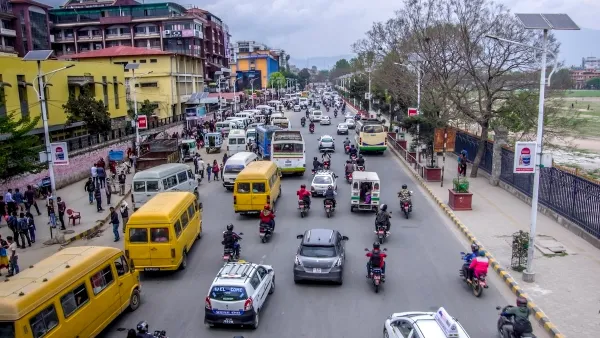
The Small South Asian Republic Going all in on EVs
Thanks to one simple policy change less than five years ago, 65% of new cars in this Himalayan country are now electric.
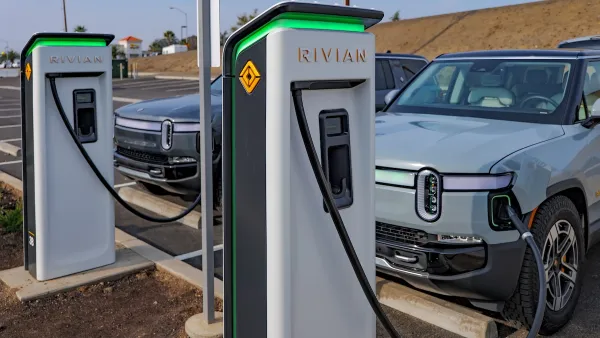
US Senate Reverses California EV Mandate
The state planned to phase out the sale of gas-powered cars by 2035, a goal some carmakers deemed impossible to meet.

Planetizen Federal Action Tracker
A weekly monitor of how Trump’s orders and actions are impacting planners and planning in America.

The state-sanctioned urbicide of Austin
People don’t kill cities. Freeways do.

US to reduce Colorado River water deliveries to Mexico
A new Colorado Treaty amendment reduces Mexico’s Colorado River water allocation by 250,000 acre feet.

5 New England states march closer to 800 megawatt wind energy project
Securing federal approval for the project may be complicated under the Trump administration, which has historically been hostile towards domestic wind power.

Baltimore to break ground on $50 million Transit Priority Project
The project will bring faster bus trips, safer streets and better bike connections to Baltimore.

Airbnb launches $250 million 'last-dollar financing' housing accelerator, makes first investment in Austin
The company will put $6.4 million towards affordable housing development in Texas’ capital.

FREE Course: Walkable City 1: Why Walkability?
After describing his path towards focusing on walkability as the essence of good planning, Jeff Speck marches through his five principal reasons for making more walkable places.
Reinventing Malls: Planning Alchemy—Turning Gray Fields Into Gold
The course focuses on the opportunities and imperatives that shape reinvention of mall sites.

Eagle County Government
Harvard University Graduate School of Design
Nashville Planning Department
The Architects Foundation
University of Cincinnati Online
The Pocatello Development Authority
The Urban Renewal Agency of the City of Pocatello
Journal of the American Planning Association