A shift is underway on Wall Street—investors are acknowledging the risks of climate change. A recent credit-ratings report on the bridge system connecting Miami to Key Biscayne provides a stark example of the new way of thinking.


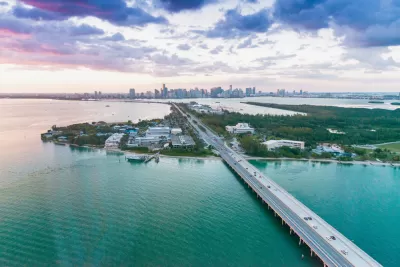
"Each year, the Fitch credit-ratings firm issues a report on debt backed by tolls collected on Miami’s Rickenbacker Causeway, the bridge system connecting downtown to the shores of Key Biscayne," reports Douglas Hanks.
"On Thursday, Fitch debuted a new cash-flow concern for the Rickenbacker. 'Given its location,' Fitch analysts wrote, 'the causeway is exposed to extreme weather events in relation to rising sea levels and vulnerable to traffic and revenue disruptions.'"
The commentary on the risk of sea-level facing the bridge was triggered by a new scoring system implemented by Fitch in May, which includes a estimates on environmental risks, explains Hanks. Miami-Dade County seems sensitive to the idea that climate change poses risks to its borrowing and binding capacities. The county, "began including disclosures about climate change risks in the regulatory documents it must file for investors in county bonds," reports Hanks.
The state is planning to spend $2.5 million next year on a two-year analysis of the future of the bridges on the Rickenbacker.
Read the full story: The Miami bridge to Key Biscayne sparks a new worry on Wall Street: rising seas Read more here: https://www.miamiherald.com/new

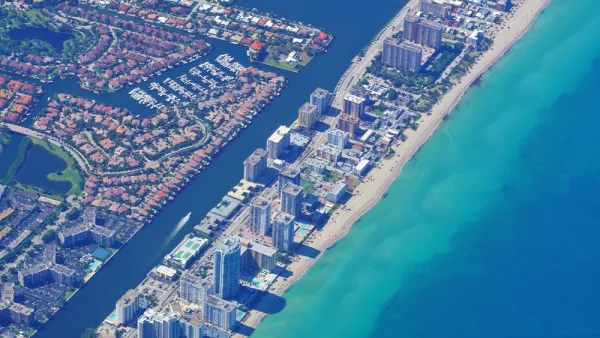
Florida Real Estate Market Sounds Climate Alarms
New research suggests that real estate values were declining before prices started falling, but a climate-driven housing crisis could already be here in coastal Florida.
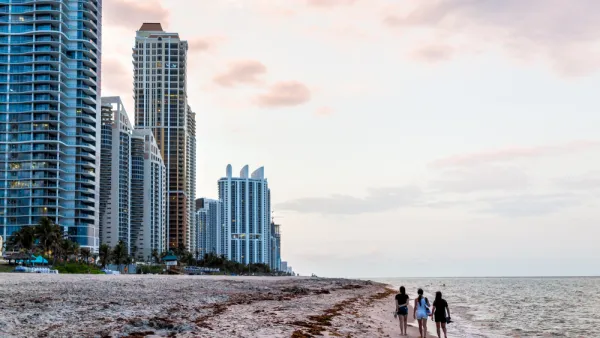
Miami Has the Most to Lose From Climate Change, Study Says
A new report by Resources for the Future, a nonpartisan economic think tank, claims that Miami is the most vulnerable coastal city in the world.
Sea-Level Rise Report: Bad News for South Florida
A climate change conference in Southeast Florida this week delivers bad news for communities on the coast in South Florida and in the Florida Keys. Some of those communities won't be saved as the receipts for climate change come in.

Planetizen Federal Action Tracker
A weekly monitor of how Trump’s orders and actions are impacting planners and planning in America.

The state-sanctioned urbicide of Austin
People don’t kill cities. Freeways do.

US to reduce Colorado River water deliveries to Mexico
A new Colorado Treaty amendment reduces Mexico’s Colorado River water allocation by 250,000 acre feet.

Nation's most wind-powered state turns to coal as data centers increase energy demand
For the first time in decades, Iowa has increased its generation of coal power.

NYC cools commuters with city's first rain garden above a bus stop
New York City officials say the plants in the rain garden can absorb 16 gallons of rainwater during heavy storms.

Brightline West’s future may rely on $6 billion federal loan
The company has until Nov. 2 to make a $400 million equity investment into its proposed high-speed rail line.

FREE Course: Walkable City 1: Why Walkability?
After describing his path towards focusing on walkability as the essence of good planning, Jeff Speck marches through his five principal reasons for making more walkable places.
Reinventing Malls: Planning Alchemy—Turning Gray Fields Into Gold
The course focuses on the opportunities and imperatives that shape reinvention of mall sites.

Greater Baltimore Committee
Eagle County Government
Harvard University Graduate School of Design
The Architects Foundation
University of Cincinnati Online
The Pocatello Development Authority
The Urban Renewal Agency of the City of Pocatello
Journal of the American Planning Association