Applying a cordon toll as low as $4 in Los Angeles would result in a 20% reduction in traffic congestion and modest increases in transit ridership, walking, and biking, according to a new study from the Southern California Association of Governments.


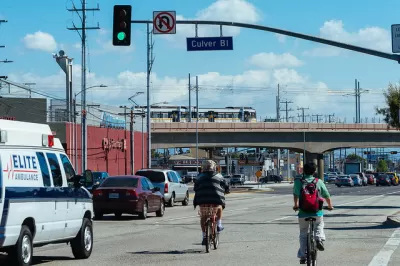
In less than two years, if all goes according to plan, motorists driving into Manhattan between The Battery and 60th Street will be subject to a cordon charge "well over $10" now that Gov. Andrew Cuomo signed the state budget bill on April 1 that includes authorization to establish a Central Business District tolling program. Planners and policymakers in other large, traffic-congested cities in America have taken notice.
"[I]n Southern California, elected officials have approached the question of congestion pricing with trepidation, saying that such a dramatic shift in a driving-dependent region would require detailed study of its impacts," reports Laura J. Nelson, who covers transportation and mobility issues across Southern California for the Los Angeles Times, on March 28.
The region’s first such study, released Thursday by the Southern California Assn. of Governments [SCAG], suggests that charging drivers to enter an area of West Los Angeles and Santa Monica just west of the 405 Freeway and north of the 10 Freeway could significantly smooth out rush-hour traffic jams and speed commute times.
A $4 fee to drive into the 4.3-square-mile area during weekday rush hour could almost immediately reduce traffic delays and miles driven there by more than 20%, the analysis found.
The cordoned area, called a "go zone" in the study, "is the fairest approach to reducing congestion and greenhouse gas emissions," said Darin Chidsey, Executive Director of SCAG, in the press release [pdf] for the 156-page "Mobility Go Zone & Pricing Feasibility Study" [pdf].
“The pricing model means that people who contribute the most to traffic will pay the most. And for low-income communities, who are often the most harmed by congestion, improved traffic flow and new transit investments will be a huge benefit.”
Of course, improved traffic flow will also benefit those who choose to "drive and pay," and from an demographic perspective, drivers who enter the go zone "would come from wealthy communities, including Brentwood, Bel Air and Westwood," adds Nelson.
At first glance, it might seem that the charge would be too low to make a 20 percent reduction in vehicle miles traveled and traffic congestion, but even a congestion charge 60 percent lower than may be charged in Manhattan in about 18 months (assuming all goes well), the results would be dramatic according to their analysis, writes Nelson.
Such a drop in driving would correspond with a 9% increase in transit ridership, a 7% increase in biking and a 7% increase in walking inside the zone, indicating that the region doesn’t need sky-high tolls “to really affect the kind of behavior change that we’re looking for,” said Annie Nam, the SCAG manager who oversaw the study.
SCAG, a six-county council of governments (CoG) and the region's metropolitan planning organization (MPO), is not proposing to implement congestion pricing, which is what the Los Angeles County Metropolitan Transportation Authority (Metro) plans to do. A month earlier (Feb. 28), Metro announced that they will prepare their own feasibility study on congestion pricing which will be quite different in its scope.
Steve Hymon, editor of The Source, Metro's official blog, distinguishes the SCAG study from what the Los Angeles County Metropolitan Transportation Authority will do.
Our agency is working with SCAG and will use their research as a starting point for Metro’s feasibility study. The important point here: the Metro feasibility study will be the one that determines what is done on a pilot basis for congestion relief pricing in Los Angeles County.
Like Manhattan's Central Business District tolling program, state legislation will be required for any cordon tolling program in California, and that in itself is challenging. Key to the New York State legislature's approval of congestion pricing for Manhattan was that the provisions were included in the Fiscal Year 2020 budget bill, which, by law, had to be signed before April 1. It was a day late.
“Communities around [California] are calling for creative ways to address congestion and improve mobility. It’s time for the state to heed that call,” said Assemblymember Richard Bloom, of Santa Monica in the SCAG press release.
“We have seen congestion pricing work around the world and this report shows us that it can work in California’s beleaguered cities, as well. I hope to facilitate ‘Go Zones’ with legislation allowing for a small number of locally determined pilot projects that provide measurable community benefits.”
Bloom had introduced legislation last year to establish Go Zones in four cities. Bloom pulled the bill prior to its first committee hearing.
“It’s challenging,” state Sen. Scott Wiener, D-San Francisco, who co-sponsored Bloom’s bill last year, told San Francisco Chronicle transportation reporter Rachel Swan (posted here).
“People just aren’t used to paying for the cost of driving,” he added, referring to what it costs to build and maintain roads, not for gas and tuneups.
Hopefully, if success is achieved in midtown Manhattan, drivers, transit riders, cyclists and pedestrians will see the benefits that result when driving is no longer treated as an entitlement, but like other modes of transportation, e.g., riding a bus or train, it comes with a price, if only within the "go zone."
Related in Planetizen:
-
Done Deal: Manhattan Congestion Pricing, April 2, 2019
-
Equity Considerations Delay Congestion Pricing in Los Angeles, January 31, 2019
-
Transit Agency Chief to Propose Congestion Pricing for Los Angeles, January 21, 2019
-
Los Angeles Could Charge Non-Residents to Drive in Congested Areas, September 15, 2017
Hat tip to Len Conly.
FULL STORY: Pay $4 to drive to the Westside? Congestion pricing could cut traffic gridlock, report says

Equity Considerations Delay Congestion Pricing in Los Angeles
After discussing a staff report on road pricing at their Jan. 24 meeting, Los Angeles County Metropolitan Transportation Authority directors paused to weigh the equity implications of charging motorists to drive on roads.
Transit Agency Chief to Propose Congestion Pricing for Los Angeles
Los Angeles Metro CEO Phil Washington will recommend to his board next Thursday that they pursue a congestion pricing program to reduce traffic congestion, improve transit, and subsidize transit fares in Los Angeles in time for the 2028 Olympics.
Bill Introduced to Allow California Cities to Pursue Congestion Pricing
Four cities could charge tolls for drivers to enter congested parts of their cities if an assembly bill introduced by Richard Bloom last month becomes law.

The state-sanctioned urbicide of Austin
People don’t kill cities. Freeways do.

US to reduce Colorado River water deliveries to Mexico
A new Colorado Treaty amendment reduces Mexico’s Colorado River water allocation by 250,000 acre feet.

New Jersey’s second-largest city bans standalone data centers
Jersey City will continue to allow co-location facilities, such as those meant for research institutions that store their own data.

Amtrak not solely to blame for New Jersey commuter rail's unreliability, report finds
A new study from the Garden State Initiative found that NJ Transit’s budget grew 20% across a 4 year period, but reliability declined significantly over the same period.

EPA erases limits on planet-warming pollution from power plants
Under Monday’s plan, power plants would still have some limits on how much mercury, arsenic and other contaminants they can emit.

Phoenix announces new on-demand transit service, more frequent RAPID buses
Both new services will launch in October, and are part of Phoenix's Project Effective Access Solutions for Easing Congestion.

FREE Course: Walkable City 1: Why Walkability?
After describing his path towards focusing on walkability as the essence of good planning, Jeff Speck marches through his five principal reasons for making more walkable places.
Reinventing Malls: Planning Alchemy—Turning Gray Fields Into Gold
The course focuses on the opportunities and imperatives that shape reinvention of mall sites.

Eagle County Government
Harvard University Graduate School of Design
Nashville Planning Department
The Architects Foundation
University of Cincinnati Online
The Pocatello Development Authority
The Urban Renewal Agency of the City of Pocatello
Journal of the American Planning Association