The $2.16 billion Transbay Transit Center opens to the public on August 11, with bus service launching on August 12.


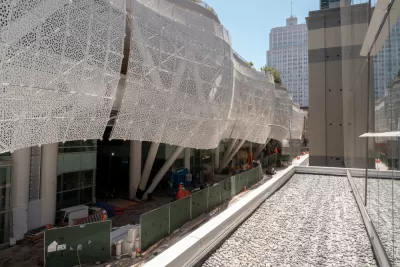
John King provides the first look at a massive new transit station and public, rooftop park in San Francisco.
Complete and scheduled to open for bus service on August 12, the $2.16 billion Transbay Transit Center "has been the subject of grand plans and political controversies, struggles to stay on schedule and squabbles over costs," according to King. But when the fist bus bound from the East Bay fee of downtown traffic on an elevated concourse, "all of that changes."
King's assessment of the new Transbay Transit Center is as part "utilitarian bus station" and "part rooftop park." It's also the city's "freshest icon."
There's no shortage of detail and intrigue to be found at San Francisco's new icon. For instance, it will be important to note the preferred nomenclature. According to King, "the facility now officially bears the name Salesforce Transit Center, with Salesforce Park on top. That’s the trade-off for a 25-year, $110 million sponsorship deal with the tech firm, which is headquartered next door."
From design elements to programming plans to addressing concerns about security to plans to eventually bring train service to the facility (at a final cost of $4.2 billion), King covers a lot of ground with this feature-length story, complete with several high-quality video vignettes. We'll leave one final note of enticement toward the source article with this key passage:
But consider what has been accomplished. A major work of 21st century infrastructure has not only been summoned into existence, it has helped summon up a neighborhood around it. The notion of a larger public — public transit and public spaces and large-scale public investment — is being celebrated, not scorned.
FULL STORY: San Francisco’s imposing transit center ready to roll at last


Cracked Beams Repaired, S.F.'s Transbay Transit Center Ready to Reopen
Buses and people will soon return to the Transbay Transit Center, which operated for just over a month at the end of 2018 before structural flaws forced the closure of the facility for inspections and repairs.
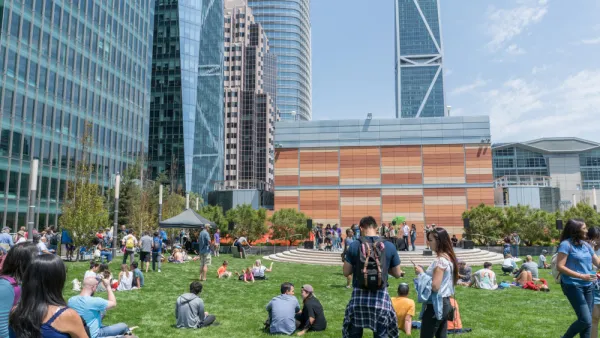
S.F.'s Transbay Transit Center Won't Reopen Until June at the Earliest
The Transbay Transit Center, opened for a brief stint in the latter half of 2018 before structural flaws were discovered, won't be open to the public again anytime soon.
SF Transbay Transit Center Cracks Isolated to Beams, Say Experts
As the investigation continues, cracks found in girders supporting the building do not appear to be due to a design issue.

The state-sanctioned urbicide of Austin
People don’t kill cities. Freeways do.

US to reduce Colorado River water deliveries to Mexico
A new Colorado Treaty amendment reduces Mexico’s Colorado River water allocation by 250,000 acre feet.

New Jersey’s second-largest city bans standalone data centers
Jersey City will continue to allow co-location facilities, such as those meant for research institutions that store their own data.

Amtrak not solely to blame for New Jersey commuter rail's unreliability, report finds
A new study from the Garden State Initiative found that NJ Transit’s budget grew 20% across a 4 year period, but reliability declined significantly over the same period.

EPA erases limits on planet-warming pollution from power plants
Under Monday’s plan, power plants would still have some limits on how much mercury, arsenic and other contaminants they can emit.

Phoenix announces new on-demand transit service, more frequent RAPID buses
Both new services will launch in October, and are part of Phoenix's Project Effective Access Solutions for Easing Congestion.

FREE Course: Walkable City 1: Why Walkability?
After describing his path towards focusing on walkability as the essence of good planning, Jeff Speck marches through his five principal reasons for making more walkable places.
Reinventing Malls: Planning Alchemy—Turning Gray Fields Into Gold
The course focuses on the opportunities and imperatives that shape reinvention of mall sites.

Eagle County Government
Harvard University Graduate School of Design
Nashville Planning Department
The Architects Foundation
University of Cincinnati Online
The Pocatello Development Authority
The Urban Renewal Agency of the City of Pocatello
Journal of the American Planning Association