Ridership is declining on TriMet's Westside Extension Service, reflecting declines on other parts of the system. This commuter rail line, however, has its own unique set of issues.


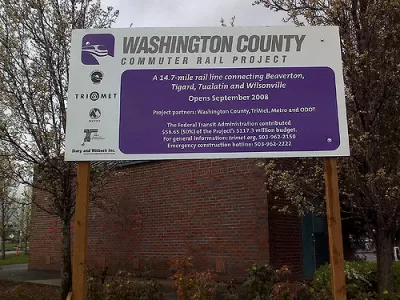
Andrew Theen reports on significant declines in ridership on TrimMet's Westside Extension Service (WES) commuter rail line.
"Nine years ago, the transit agency officially got into the heavy-rail business with the 14.7-mile suburban route between Wilsonville and Beaverton," according to Theen. "And ever since, ridership has consistently failed to live up to TriMet's original projections."
March boardings were down 13.2 percent compared to the same month the year before, according to data recently released by TriMet. "The tepid ridership comes despite record-low unemployment levels in the Portland area and amid ever-growing grumbling about stifling congestion on Interstates 5 and 205, Oregon 217 and U.S. 26," adds Theen. Ridership is dropping on TriMet's bus and light rail routes. The plan to recover some of the last ridership along the WES route—marketing to new developments built along the corridor.
Read the full story: WES train ridership down 13 percent from 2017, but TriMet rolls on

TriMet will eliminate 'Hand-to-Hand' paratransit service for half of its users
Roughly 300 Portland-area paratransit riders will lose access to a program that lets drivers escort them into their destination.
Portland transit announces deep service cuts, hundreds of layoffs
The TriMet agency is cutting service on multiple transit lines, reducing customer service phone hours and eliminating over 100 staff positions.

Portland gathers to pay respects to the last of its original light rail cars
The TriMet agency has fully replaced its aging fleet of Type 1 cars.

Planetizen Federal Action Tracker
A weekly monitor of how Trump’s orders and actions are impacting planners and planning in America.

California plans to bury El Niño’s downpour
If the state plays its cards right, it may be able to store a billion acre-feet of El Niño’s water in aquifers.

Chicago breaks ground on $3 billion megadevelopment
The new neighborhood, titled Foundry Park, will one day host 3,700 residences.

California High-Speed Rail Authority CEO resigns after $600,000 scandal
Under Ian Choudri, the authority used taxpayer dollars to fund first class flights and trips to nightclubs.

Want to study the Missouri River? Soon, you may need unanimous approval from 10 states
Legislation would require 10 governors’ permission to study or build projects moving water outside the basin.

Desperate measures: Advocates weigh draining Lake Powell to fill Colorado River
Draining the reservoir could reduce evaporation losses by a couple hundred thousand acre-feet.

FREE Course: Walkable City 1: Why Walkability?
After describing his path towards focusing on walkability as the essence of good planning, Jeff Speck marches through his five principal reasons for making more walkable places.
Reinventing Malls: Planning Alchemy—Turning Gray Fields Into Gold
The course focuses on the opportunities and imperatives that shape reinvention of mall sites.

City of Rosemead
Rutgers University, Edward J. Bloustein School of Planning and Public Policy
One Hundred Miles
Hunter College, City University of New York (CUNY)
The Architects Foundation
University of Cincinnati Online
City of Cambridge
Montrose County
The Pocatello Development Authority