Faced with the potential consequences of the federal Communications Commission's recent repeal of net neutrality, a report by the American Civil Liberties Union suggests that municipal internet as an antidote.



"The American Civil Liberties Union (ACLU) has released a report encouraging local governments to provide public broadband to counteract the federal net neutrality repeal," reports Katie Pyzyk.
The report's value proposition for municipal internet includes references to privacy and net neutrality. On the former issue, municipal governments would have more oversight in protecting user privacy, and on the latter issue, municipal government can help maintain the democratic ideals of a free and open internet.
"The report suggests that a number of broadband investment options exist," according to Pyzyk. "A municipality can go "all in" and provide full internet service to each household, or it could require private telecom providers to respect free internet principles in order to use publicly owned assets such as pipes, tubes and other cable conduits."
Read the full story: ACLU encourages city-owned public internet to protect net neutrality
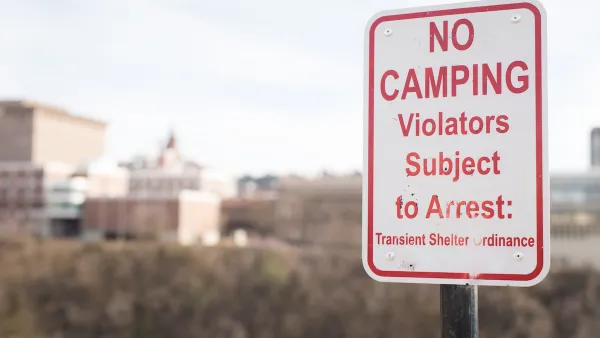
ACLU Sues Washington State for Anti-Camping Laws
In the first legal challenges since June’s U.S. Supreme Court decision that cities can enforce outdoor sleeping bans, the ACLU filed a lawsuit alleging Washington’s anti-camping laws violate the state constitution.
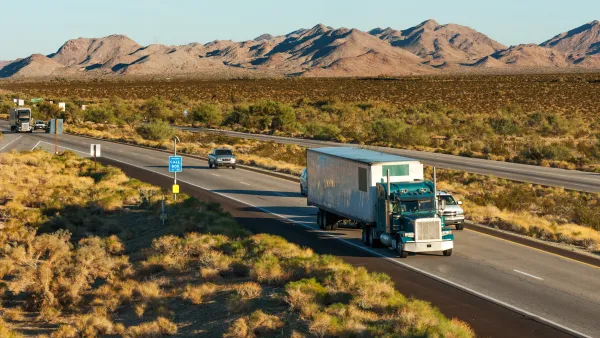
Arizona to Build ‘Testbed’ for Autonomous Vehicles
The Arizona Department of Transportation announced a public-private partnership to install fiber-optic infrastructure along 405 miles of interstate highways to enable vehicle connectivity.

Federal Program Funds Broadband in Underserved Areas
The program supports efforts to improve internet connectivity in remote and rural areas.

Planetizen Federal Action Tracker
A weekly monitor of how Trump’s orders and actions are impacting planners and planning in America.

California plans to bury El Niño’s downpour
If the state plays its cards right, it may be able to store a billion acre-feet of El Niño’s water in aquifers.

Desperate measures: Advocates weigh draining Lake Powell to fill Colorado River
Draining the reservoir could reduce evaporation losses by a couple hundred thousand acre-feet.

Mamdani’s pied-à-terre tax survives legal challenge
A panel of judges found that the plaintiffs failed to demonstrate injury as a result of New York City's implementation of the tax.

Eastern Nebraska is running out of electricity
Data centers and electrification are straining eastern Nebraska’s grid, throttling economic development.

Seattle passes record-breaking transit services expansion
Proposition 1 will double the city’s transit tax to add 95,000 more bus trips and preserve 180,000 bus trips annually.

FREE Course: Walkable City 1: Why Walkability?
After describing his path towards focusing on walkability as the essence of good planning, Jeff Speck marches through his five principal reasons for making more walkable places.
Reinventing Malls: Planning Alchemy—Turning Gray Fields Into Gold
The course focuses on the opportunities and imperatives that shape reinvention of mall sites.

City of Rosemead
Rutgers University, Edward J. Bloustein School of Planning and Public Policy
One Hundred Miles
University of Michigan School for Environment and Sustainability (SEAS)
Hunter College, City University of New York (CUNY)
The Architects Foundation
City of Cambridge
Montrose County
The Pocatello Development Authority