In the first legal challenges since June’s U.S. Supreme Court decision that cities can enforce outdoor sleeping bans, the ACLU filed a lawsuit alleging Washington’s anti-camping laws violate the state constitution.


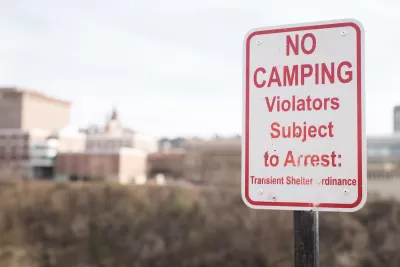
According to an Associated Press article published by ABC News by Clarie Rush, the American Civil Liberties Union filed a lawsuit against the city of Spokane, Washington, on Thursday, alleging that its anti-camping laws violate the state's constitution. Experts believe this is the country's first such legal challenge since the U.S. Supreme Court ruled in June that cities can enforce outdoor sleeping bans even when alternate shelter is not available.
The Supreme Court’s ruling, which many call a landmark decision, found that Grants Pass, Oregon’s camping bans do not violate the Eighth Amendment, which protects against cruel and unusual punishment, even when shelter space is not available. Jazmyn Clark, director of the ACLU of Washington’s Smart Justice Policy Program, told The Associated Press, that Washington State’s constitution only prohibits cruel punishment, with no mention of unusual punishment, which means that if punishing sleeping outside with fines and jail time — Spokane’s ordinances make camping, sitting, or lying on public property misdemeanor crimes, which under state law are punishable by a fine up to $1,000 or jail up to 90 days — is found to be cruel, “that alone is a violation of the state constitution.” Thus, Washington’s state constitution provides more protection than the Eighth Amendment because you do not need to show that the punishment is also unusual.
The lawsuit comes as cities across the country have instituted their own camping bans, following the Supreme Court decision. And while this case is specific to Washington, it could have implications beyond state lines. According to the article, other state constitutions, including those of Pennsylvania, Delaware, Rhode Island, Kentucky and South Dakota, similarly prohibit cruel punishment without mentioning “unusual” punishment.
Read the full story: ACLU sues Washington state city over its anti-homeless laws after a landmark Supreme Court ruling
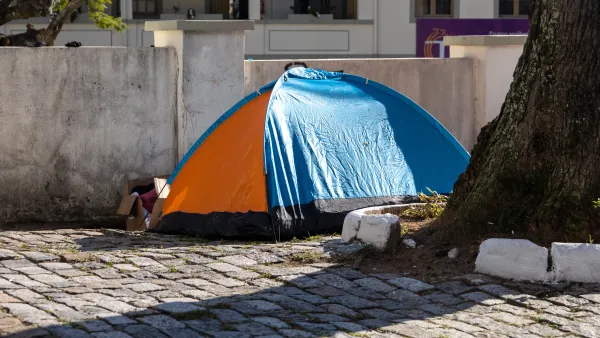
U.S. Supreme Court Upholds Camping Bans, but Challenges of Addressing Homelessness Remain
In Grants Pass v. Johnson, the Supreme Court upheld an Oregon city’s ban on camping in public places, paving the way for similar bans in cities across the country but doing nothing to solve the cause of homelessness.
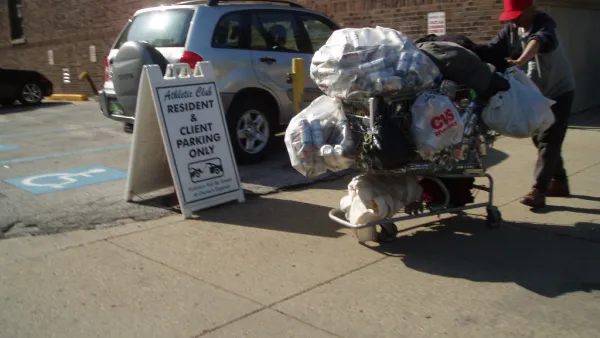
Indiana bans public homelessness
A new law prohibits sleeping or camping on public property.
Gallatin County, Montana Passes Ban on Public Camping
The Gallatin County Commission last week approved an ordinance banning camping on public property and within public rights-of-way.

Planetizen Federal Action Tracker
A weekly monitor of how Trump’s orders and actions are impacting planners and planning in America.

California plans to bury El Niño’s downpour
If the state plays its cards right, it may be able to store a billion acre-feet of El Niño’s water in aquifers.

Desperate measures: Advocates weigh draining Lake Powell to fill Colorado River
Draining the reservoir could reduce evaporation losses by a couple hundred thousand acre-feet.

Mamdani’s pied-à-terre tax survives legal challenge
A panel of judges found that the plaintiffs failed to demonstrate injury as a result of New York City's implementation of the tax.

Eastern Nebraska is running out of electricity
Data centers and electrification are straining eastern Nebraska’s grid, throttling economic development.

Seattle passes record-breaking transit services expansion
Proposition 1 will double the city’s transit tax to add 95,000 more bus trips and preserve 180,000 bus trips annually.

FREE Course: Walkable City 1: Why Walkability?
After describing his path towards focusing on walkability as the essence of good planning, Jeff Speck marches through his five principal reasons for making more walkable places.
Reinventing Malls: Planning Alchemy—Turning Gray Fields Into Gold
The course focuses on the opportunities and imperatives that shape reinvention of mall sites.

City of Rosemead
Rutgers University, Edward J. Bloustein School of Planning and Public Policy
One Hundred Miles
University of Michigan School for Environment and Sustainability (SEAS)
Hunter College, City University of New York (CUNY)
The Architects Foundation
City of Cambridge
Montrose County
The Pocatello Development Authority