Judging by the private-sector interest in a plan to expand Interstate 270 and the Capital Beltway in Maryland, the state won't have any trouble finding willing partners.


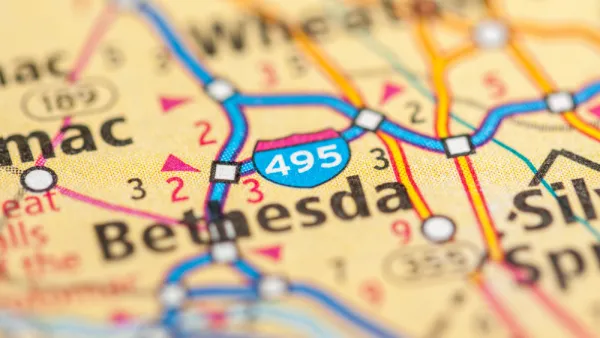
"Maryland is moving forward on its plan to add four toll lanes to both Interstate 270 and the Capital Beltway," report Andrew Metcalf.
"On Thursday, the state’s transportation department announced it received 27 responses to its request for initial information from companies interested in financing, building and operating the estimated $7.6 billion project," adds Metcalf.
The news about the state's plans to add the Capital Beltway and I-270 broke in September 2017, when the focus was on the project's potential to become the nation's largest ever public-private partnership.
The size of the project meant the request for initial information elicited global attention. Companies in seven companies responded to the request. Next up for the project—a request for proposals.
Read the full story: State Gets 27 Initial Inquiries From Private Companies Interested in Widening I-270, Beltway

Maryland's $9 Billion Project Would Be the Nation's Largest P3 for Highways
Gov. Larry Hogan (R-Md.) announced last week plans for the largest highway contract awarded to a public-private partnership: adding four express toll lanes to the Capital Beltway and I-270. A third highway widening will be completed internally.
Maryland Highway Plan Would Destroy Affordable Housing, Displace Low-Income Residents
A local writer compares the plan to expand I-270 and the Capital Beltway to an earlier era of transportation planning.
Local Control Proposed to Halt Toll Road Progress in Maryland
State legislators want counties to be able to veto toll projects proposed by Governor Larry Hogan.

Planetizen Federal Action Tracker
A weekly monitor of how Trump’s orders and actions are impacting planners and planning in America.

California plans to bury El Niño’s downpour
If the state plays its cards right, it may be able to store a billion acre-feet of El Niño’s water in aquifers.

Chicago breaks ground on $3 billion megadevelopment
The new neighborhood, titled Foundry Park, will one day host 3,700 residences.

California High-Speed Rail Authority CEO resigns after $600,000 scandal
Under Ian Choudri, the authority used taxpayer dollars to fund first class flights and trips to nightclubs.

Want to study the Missouri River? Soon, you may need unanimous approval from 10 states
Legislation would require 10 governors’ permission to study or build projects moving water outside the basin.

Desperate measures: Advocates weigh draining Lake Powell to fill Colorado River
Draining the reservoir could reduce evaporation losses by a couple hundred thousand acre-feet.

FREE Course: Walkable City 1: Why Walkability?
After describing his path towards focusing on walkability as the essence of good planning, Jeff Speck marches through his five principal reasons for making more walkable places.
Reinventing Malls: Planning Alchemy—Turning Gray Fields Into Gold
The course focuses on the opportunities and imperatives that shape reinvention of mall sites.

City of Rosemead
Rutgers University, Edward J. Bloustein School of Planning and Public Policy
One Hundred Miles
Hunter College, City University of New York (CUNY)
The Architects Foundation
University of Cincinnati Online
City of Cambridge
Montrose County
The Pocatello Development Authority