While late to adopt bus rapid transit, San Francisco's Muni is planning to bring fully-fledged BRT lines, complete with dedicated lanes, to the city by 2010.


"Two bus rapid transit systems are already rolling in the Bay Area -- AC Transit's 72-R rapid bus along San Pablo Avenue in the East Bay -- and the Santa Clara Valley Transportation Authority's 522-Rapid between East San Jose and Palo Alto in the South Bay. Before the end of the year, AC Transit plans to launch a second speedy bus line from San Leandro to the UC Berkeley campus.
All three of those lines are minimalist versions of true bus rapid transit, relying on fewer bus stops and traffic signal. The most efficient bus rapid transit systems also have completely dedicated lanes and boarding platforms, for example.
Nevertheless, AC Transit spokesman Clarence Johnson said the 72-R service, which started in 2003, "is a real glowing success". A survey of riders found that more than half saved at least 10 minutes on the 72-R. Ridership, he said, "more than doubled."
"Both AC and VTA chose to start small, rolling out what they could afford, then eventually upgrading by adding dedicated lanes, miniature stations and ticket machines at bus stops, and other features."
"San Francisco's Muni, which hauls about 600,000 passengers a day, is taking a different approach. Rather than starting with the bare-bones version of bus rapid transit and upgrading, Muni plans to start with a full-featured system, including dedicated lanes, on bus lines on Van Ness Avenue and Geary Boulevards. They're expected to be in service by 2010 and 2011, respectively. The Van Ness line is expected to cost $65 million, the Geary line about $150 million."
"Each will feature high-capacity low-floor buses, dedicated lanes -- either on the sides or in the center of the road -- and high-quality bus shelters much like the Third Street light rail stations. They'll have real-time bus information and ticket vending machines, and they'll be 11 inches above the ground "so that passengers can walk on from the platform" without having to climb stairs, said Julie Kirschbaum, senior planner for the authority.
Muni will continue to run local buses that make regular stops -- but they won't be so speedy."
Thanks to MTC-ABAG Library
FULL STORY: Transportation planners cheer bus rapid transit

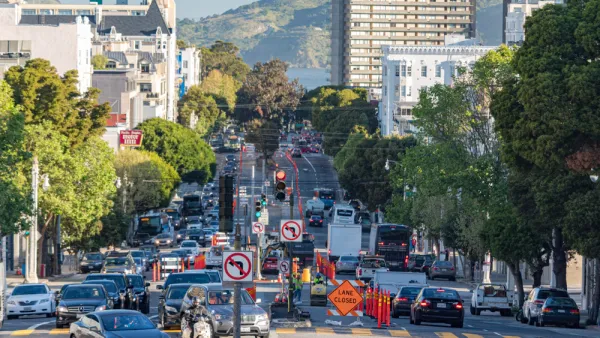
Once San Francisco's 'Grandest Boulevard,' Van Ness Almost Done With Another Makeover
The Van Ness Improvement project took almost two decades to cross the finish line, but it's almost there.
More Details of Bus Rapid Transit's Expanding Reach in San Francisco
The Geary bus corridor was the #1 pick for a subway according to a Muni survey, but commuters will have to settle for bus rapid transit. A milestone was reached when the San Francisco County Transportation Authority approved the design and EIR.
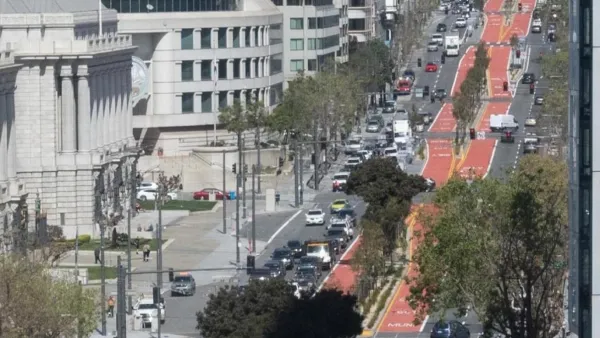
San Francisco Bus Rapid Transit Performing Well, One Month In
After a month of service, the Van Ness BRT line has cut travel times by roughly nine minutes and spurred increased ridership.

Planetizen Federal Action Tracker
A weekly monitor of how Trump’s orders and actions are impacting planners and planning in America.

The state-sanctioned urbicide of Austin
People don’t kill cities. Freeways do.

US to reduce Colorado River water deliveries to Mexico
A new Colorado Treaty amendment reduces Mexico’s Colorado River water allocation by 250,000 acre feet.

Airbnb launches $250 million 'last-dollar financing' housing accelerator, makes first investment in Austin
The company will put $6.4 million towards affordable housing development in Texas’ capital.

Guerilla urbanists are building DIY bus stop benches in Chicago
A before-and-after of one of the bus stops with a new bench. The new benches are not officially sanctioned or permitted, but the residents who placed them hope they will be the start of a network of DIY benches across the city.

Mamdani overhauls NYC's Vision Zero plan with 100 new policy goals
The overhaul aims to reduce traffic deaths and make streets safer for pedestrians, cyclists and drivers through lower speed limits, new safety infrastructure and more.

FREE Course: Walkable City 1: Why Walkability?
After describing his path towards focusing on walkability as the essence of good planning, Jeff Speck marches through his five principal reasons for making more walkable places.
Reinventing Malls: Planning Alchemy—Turning Gray Fields Into Gold
The course focuses on the opportunities and imperatives that shape reinvention of mall sites.

Eagle County Government
Harvard University Graduate School of Design
Nashville Planning Department
The Architects Foundation
University of Cincinnati Online
The Pocatello Development Authority
The Urban Renewal Agency of the City of Pocatello
Journal of the American Planning Association