Environment
Checking in on Lake Erie's $3 Billion 'Project Clean Lake'
A rainwater retention facility in Cleveland represents a small step forward with a controversial 25-year, $3 billion plan to clean Lake Erie.
An Interview with Kaid Benfield, Urban Resilience Guru
PlaceMakers asks Kaid to give us his idea of where we are in the effort to integrate smart growth strategies in the broadest sense into community planning and design.
Seattle's 'Subirdia' Allows Birds to Thrive
According to a book by John Marzluff, "Welcome to Subirdia: Sharing Our Neighborhoods with Wrens, Robins, Woodpeckers, and Other Wildlife," Seattle's greatest diversity of birds lives in its suburbs.
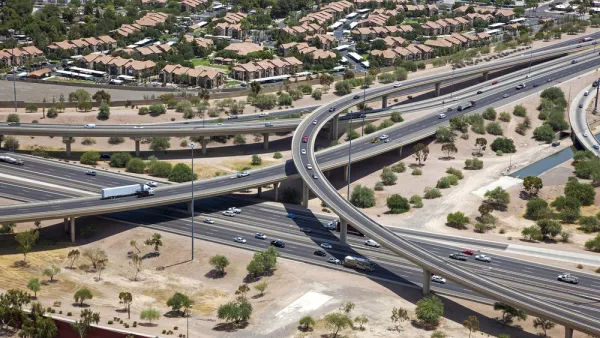
Research: Women Living Near Freeways Increase Risk of Sudden Cardiac Death
New research from the American Heart Association measures sudden cardiac death and proximity to major roadways, showing that cardiac risks posed by environmental exposure have been under-appreciated. The next step is to find the specific cause.
Tallahassee's Climate Apathy Drives South Florida Secession Movement
South Miami, population 11,657, has had enough with the Florida legislature's intransigence at combatting climate change, so it has launched a secession movement for 24 southern counties to secede from the northern part of the state.
Los Angeles Embraces Urban Agriculture
A motion passed earlier this month calls for landowners to receive tax breaks for leasing vacant property for agriculture and farming.
Calling on Urban Designers to Lead the Fight Against Climate Change
Alan G. Brake writes an editorial calling on the architecture and urbanism fields to push even further to reduce carbon emissions by designing (and upgrading) efficient buildings.
APA Seeking Input for Updated 'Planning for Sustainability Policy Guide'
The American Planning Association (APA) is seeking input for an update of the 2000 Planning for Sustainability Policy Guide.
The Incredible Climate Mitigation Potential of Compost
Research has shown that the world's largest land use, grazing, holds enormous potential when linked with composting, to dramatically reduce the carbon content of the atmosphere through sequestration while concurrently restoring degraded rangeland.
Report: Expect Regular Coastal Floods Within 15 Years
Climate change and rising seas will mean higher flood risks for cities. But when exactly will impactful flooding become a regular occurrence? New analysis by the Union of Concerned Scientists says that time is fast approaching.
How D.C.'s 11th Street Bridge Will Transform Infrastructure into Civic Space
Across the US, cities increasingly view waterfronts as opportunities for green space. Once tied to industrial uses, river fronts now offer a chance to repurpose existing infrastructure for public use.
Keeping Cities in the Dark
There's a third dimension to sprawl: all those photons that emanate from street lights, houses, and vehicles. As author Paul Bogard discusses in The End of Night, light pollution is an overlooked menace that presents a new frontier for planners.
What Next for 'Rebuild By Design'?
The Rebuild By Design competition attracted plenty of hoopla thanks to its $920 million and the critical need for projects that protect coastal cities as sea levels rise. Now that the winners have been picked, how will they deliver on their promise?
Things Millennials Say: 'Don't Call Me an Environmentalist!'
In its ongoing series on millennials, NPR visits a three-generation family; all are environmentally-oriented, but the youngest refuses to label herself as an environmentalist even though she got upset when her boyfriend's family did not compost.
New York Department of City Planning Releases Flood Retrofitting Manual
As federal law shifts to address resilience in post-Hurricane Sandy New York, the Department of City Planning has released a new manual to help residents and landowners understand options for retrofitting their buildings to prepare for floods.
How to Solve the Looming Water Crisis
David Sedlak, author of "Water 4.0: The Past, Present, and Future of the World's Most Vital Resource," explains how the deepening obsolescence of our water infrastructure is reaching crisis status.

Trees In Urban Design: Are You Planting a Liability or Growing an Asset?
Trees are a vital element of urban design, one that must considered at every stage of planning, design and development.
California Refineries Prepare to Receive Cheaper Crude-by-Rail
The surge in oil production has not benefited California, but that's about to change. Shale oil from North Dakota and other states costs $15 less than imported oil. After transportation costs, California refineries would save $3 per barrel.
2014 APA California Conference in the Happiest Place on Earth
This year’s California American Planning Association conference convened at Disneyland and covered some innovative environmental, active transportation, and park plans and programs, including Disney’s own green practices, writes planner Clement Lau.

Friday Funny: The Onion has Been Reading Donald Shoup
The satirical news site The Onion is back with another take on the concerns of planners and transportation engineers. This time The Onion takes a page out of Donald's Shoup playbook.

FREE Course: Walkable City 1: Why Walkability?
After describing his path towards focusing on walkability as the essence of good planning, Jeff Speck marches through his five principal reasons for making more walkable places.
Reinventing Malls: Planning Alchemy—Turning Gray Fields Into Gold
The course focuses on the opportunities and imperatives that shape reinvention of mall sites.

City of Rosemead
Rutgers University, Edward J. Bloustein School of Planning and Public Policy
One Hundred Miles
University of Michigan School for Environment and Sustainability (SEAS)
Hunter College, City University of New York (CUNY)
The Architects Foundation
City of Cambridge
The Pocatello Development Authority
The Urban Renewal Agency of the City of Pocatello









