In December, the Rockefeller Foundation chose the first 33 cities to receive funding and support through its 100 Resilient Cities Challenge. Here's what comes next.


On December 3rd, the Rockefeller Foundation chose the first 33 cities to receive support through its 100 Resilient Cities challenge. Among them were New York, Rio de Janeiro, Ramallah, Bangkok, and others. Now, says Andrew Salkin, Chief Operating Officer of 100 Resilient Cities, the Rockefeller Foundation will spend the first quarter of 2014 "help those 33 cities begin to bring the right stakeholders to the table and discuss what, exactly, is resilience."
Further, he said in a video blog, once the cities choose who their Chief Resilience Officers (CROs) will be, the Rockefeller Foundation will help them devise a strategy and find financing and technical resources for their resilience projects.
Salkin goes on to discuss why certain cities were chosen -- namely New York, seeing as the city has already begun to address resilience as a core issue.
Read the full story: 100 Resilient Cities: 33 Chosen, What's Next?

Global Call for Ideas Reveals Promising Resilience Solutions
Superstorm Sandy spurred the New York City Economic Development Corporation to form the RISE:NYC program, a global competition for innovative solutions to post-disaster resiliency. Arup's Sarah Wesseler spoke with them to learn more.

In Battery Park City, Public Infrastructure Meets Climate Resilience
A massive project underway in Lower Manhattan seeks to protect the shoreline from future flooding and mitigate the effects of climate change and rising sea levels.
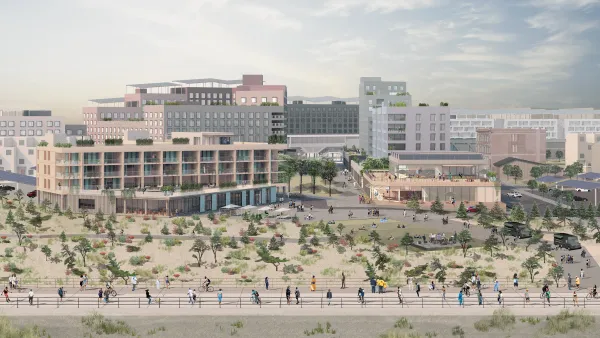
Net Zero Development Coming to New York City
The project, which relies largely on geothermal energy to minimize its carbon footprint, will bring affordable housing and boost storm resilience to an area devastated by Hurricane Sandy.

Planetizen Federal Action Tracker
A weekly monitor of how Trump’s orders and actions are impacting planners and planning in America.

Amtrak, CN end decades-long dispute with eight-year agreement
The new operating agreement establishes an updated framework for the companies to work together, including processes to resolve disputes.

Judges permit Denver to divert 77,000 acre feet from the Colorado River for reservoir expansion
Overuse and climate change have caused the Colorado River’s water levels to plummet.

NYC DOT wants faster, more permanent street upgrades
The city is examining ways to build more concrete infrastructure without getting entangled in 'decades-long' projects.

'Something we’ve never seen before:' rising utility rates could strain city finances nationwide
Data centers, climate change and other factors have caused utility rates in the United States to increase by 38% since 2020.

Trump to overrule local leaders, lease millions of acres of America’s Pacific Island territories’ seafloors to mining companies
International law says that the Indigenous people of America’s territories have a right to prior and informed consent regarding projects that impact their countries.

FREE Course: Walkable City 1: Why Walkability?
After describing his path towards focusing on walkability as the essence of good planning, Jeff Speck marches through his five principal reasons for making more walkable places.
Reinventing Malls: Planning Alchemy—Turning Gray Fields Into Gold
The course focuses on the opportunities and imperatives that shape reinvention of mall sites.

Harvard University Graduate School of Design
KFH Group Inc.
Greater Baltimore Committee
The Architects Foundation
University of Cincinnati Online
The Pocatello Development Authority
The Urban Renewal Agency of the City of Pocatello