World
Global issues, U.N., etc.
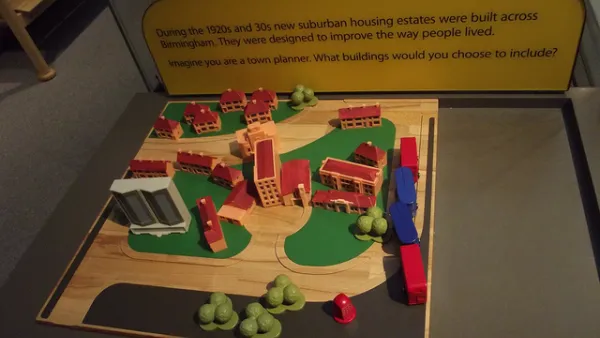
Has the Urban Planning Profession Made You Boring?
Urban planning can be an exciting and rewarding profession. It can also be extremely political and sometimes downright boring.
Mining the City
Rapid urbanization and climate change will make it harder for cities to provide crucial resources for their citizens. In this article, Arup consultants Amy Leitch and Laura Frost examine how the built environment can fill this emerging need.
The Far-Reaching, Lasting Effects of Low Oil Prices
With SUV sales up, car sales down, and mileage driven up, the effects of lower gas prices could soon extend to land use, making suburban and exurban commuting more affordable. Economists have a term for these effects: demand response.
Beyond Eternal: Identifying The World's Oldest City
Cities from India to Syria to Hungary can claim to be the world's oldest continually inhabited city, with permanent habitation going back more than 4,000 years. But when the evidence is thousands of years old, the title becomes elusive.
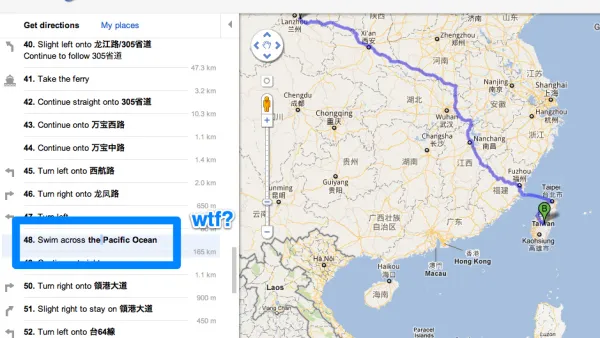
Friday Funny: How to Fail at Maps
It's too bad there isn't a map that can lead us to the place where all the fact-checkers have gone.
Lessons from 'The Human Scale'
How can we redirect our city building into a form that can handle the expected doubling of urban residents over the next 40 years? Great ideas can be found in this collection of soundbites from the film, "The Human Scale."
The Best and the Worst Airports to Access
If you want great access to an airport, go overseas—that's the main finding of a study by Golden Gateway Alliance, a Manhattan-based airport advocacy organization. Tied for dead-last in terms of access is Denver and a certain New York airport.
A Valentine's Day Message from Diversity Plaza in New York City
We at Planetizen hope that there's lots of love in your day today.
Obituary: Jon Jerde, Founder of the Jerde Partnership
Jon Jerde—one of the country's most recognizable and prolific architects and urban designers—passed away this week.
Geoengineering Studies—Plans B and C for Climate Change—Endorsed
The New York Times science writer examines the findings of the National Academy of Sciences panel released Feb. 10 that support further research on the two geoengineering strategies of carbon dioxide removal and solar radiation management.
OPEC Sees U.S. Motorists as Their Ally
An IEA report suggests that oil prices have bottomed-out, are now on the rebound, and that demand for OPEC's oil will start rising next year. OPEC predicts that U.S. oil consumption will increase after years of decline, thanks to U.S. motorists.

Reading Cities Cover to Cover, and Why
Chuck Wolfe underscores the importance of a holistic view of urban places, referencing themes of common experience, aesthetics, feelings of happiness, safety, or security—a basic narrative of the city that often goes beyond first impressions.
Asian Cities are the World's Safest
The Economist Intelligence Unit (EIU) released its Safe Cities Index 2015, finding that Asian cities lead the world in several measures of security.

Five of the World's Most Promising Examples of Environmental Conservation
A Huffington Post article shares the stories of the fellows selected by the Lincoln Institute of Land Policy to present their work at the 2014 World Parks Congress in Australia.

Friday Eye Candy: Time-Lapse Shows How Rivers Meander
"No man ever steps in the same river twice, for it's not the same river and he's not the same man." -Heraclitus, as quoted by Plato in Cratylus.

Get to Know Your Community
Seven incredibly useful market research tools for local governments.
Seizing the Moment: Nations Slash Energy Subsidies as Oil Prices Fall
Just as plummeting oil prices have caused state and federal political leaders to consider raising gas taxes, leaders in developing nations, both oil producers and consumers, are considering reductions in national energy subsidies.
Preservation vs. Emulation: Can't We All Just Get Along?
Does the emulation of historic architecture in contemporary buildings constitute fakery? Scott Doyon says, "No!"
More Details on the End of Architecture for Humanity
Following the recent news that Architecture for Humanity shut its doors after operating since 1999, FastCo.Design provides more details about what went wrong.
Report: Global Metro Economies Reveal 'An Uncertain Recovery'
A new report by the Brookings Institution's Metropolitan Policy Program analyzes the growth of the world's 300 largest metropolitan areas.

FREE Course: Walkable City 1: Why Walkability?
After describing his path towards focusing on walkability as the essence of good planning, Jeff Speck marches through his five principal reasons for making more walkable places.
Reinventing Malls: Planning Alchemy—Turning Gray Fields Into Gold
The course focuses on the opportunities and imperatives that shape reinvention of mall sites.

Eagle County Government
Harvard University Graduate School of Design
Nashville Planning Department
The Architects Foundation
University of Cincinnati Online
The Pocatello Development Authority
The Urban Renewal Agency of the City of Pocatello
Journal of the American Planning Association