A Treehugger column picks up on the historic idea of the "Linear City" as a counter point to the current pressures to build up in cities around the world.



"There is a lot of talk these days about Vertical Cities, the idea we should build supertall buildings that include all necessary functions of a city, and surround them by green space for park and agriculture," writes Lloyd Alter, "but there is another alternative that I always thought made more sense, the linear city."
Alter goes on two provide a brief history of the idea, starting from the Jersey Corridor Project, proposed by Michael Graves and Peter Eisenman in 1965. The current Michael Graves exhibition, Past as Present, showing at Grounds for Sculpture in New Jersey through April made the video below to describe the Jersey Corridor Project.
Alter concludes by arguing for the pertinence of the idea to the current development climate: "All over North America, lots of money is being spent on rail and transit infrastructure; perhaps the linear city is an idea whose time has finally come, and could help pay for it all."
Read the full story: Instead of Vertical Cities, should we be thinking about Linear Cities?

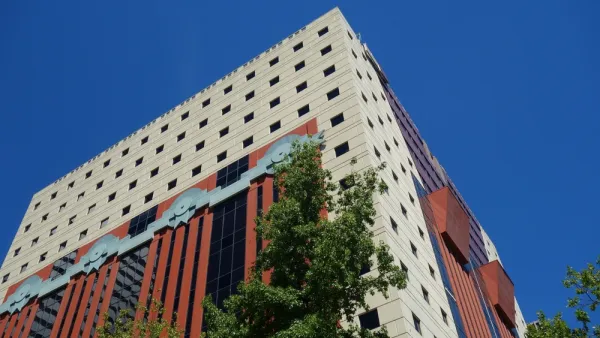
Portland Building, Remodeled Instead of Demolished, Might Lose Historic Status
A renovation saved the Portland Building, designed by postmodern pioneer Michael Graves, from demolition, but its likely doomed its status on the National Register of Historic Places.
Obituary: Michael Graves, Leading Post-Modern Architect
Michael Graves, founding principal of Michael Graves & Associates, who produced some of the world's most recognizable examples of post-modern architecture, passed away this week at 80 years old.
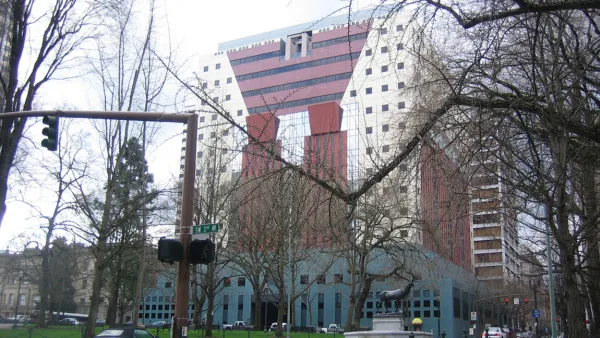
Will City Demolish Graves' Pioneering Postmodern Portland Building?
Faced with $95 million in necessary repairs just 32 years after its Michael Graves-designed administrative headquarters was opened, Portland officials are considering razing the nation's first major work of postmodern architecture.

Planetizen Federal Action Tracker
A weekly monitor of how Trump’s orders and actions are impacting planners and planning in America.

California plans to bury El Niño’s downpour
If the state plays its cards right, it may be able to store a billion acre-feet of El Niño’s water in aquifers.

Desperate measures: Advocates weigh draining Lake Powell to fill Colorado River
Draining the reservoir could reduce evaporation losses by a couple hundred thousand acre-feet.

California city breaks ground on transit connector
The project includes three mobility hubs and a pedestrian bridge.

After public outcry, Massachusetts city releases housing development tracker
Cambridge’s tracker currently shows 250 housing projects in various stages of development.

40 years after approval, Chicago breaks ground on new park
The park honors Jean Baptiste Point du Sable, the city’s first permanent non-native settler.

FREE Course: Walkable City 1: Why Walkability?
After describing his path towards focusing on walkability as the essence of good planning, Jeff Speck marches through his five principal reasons for making more walkable places.
Reinventing Malls: Planning Alchemy—Turning Gray Fields Into Gold
The course focuses on the opportunities and imperatives that shape reinvention of mall sites.

City of Rosemead
Rutgers University, Edward J. Bloustein School of Planning and Public Policy
One Hundred Miles
Hunter College, City University of New York (CUNY)
The Architects Foundation
University of Cincinnati Online
City of Cambridge
Montrose County
The Pocatello Development Authority