United States

Can a Parking Garage Village be Livable?
Students in Atlanta have designed a tiny house village inside a parking garage to help better understand how livable micro-housing projects can be.

Study Quantifies the Large Economic Cost of NIMBY Politics
A new study by economists Chang-Tai Hsieh and Enrico Moretti claims to have found the cost, in economic growth, incurred by the high price of housing in expensive coastal cities. Hint: the word trillion is involved.
Study: Inherent Flaws in Community Development Responses to Foreclosure Crisis
A new study by Laura Wolf-Powers at the University of Pennsylvania finds inherent conflict in the three varieties of response by community development practitioners to the foreclosure crisis.
Should Transit Systems Break from the Low Fare Orthodoxy?
A proposal for a radical reinvention of the fare structure for the country's transit systems—one that balances the cost of transit with that of driving, generates more revenue from fares, and enables more capital investments.
Governors Blame Congress for Failure to Sustain Highway Trust Fund
Bipartisan governors faulted Congress for failing to find long-term funds for the Highway Trust Fund, but how do their state records match their rhetoric aimed at raising federal gas taxes? Planetizen looks at some of the governors cited in the WSJ.
A History of Bi-Partisan Anti-Urbanism
Although recent studies and controversies such as Agenda 21 make anti-urban politics seem like a right wing commodity, a new book details the implications of a long history of bi-partisan anti-urbanism.
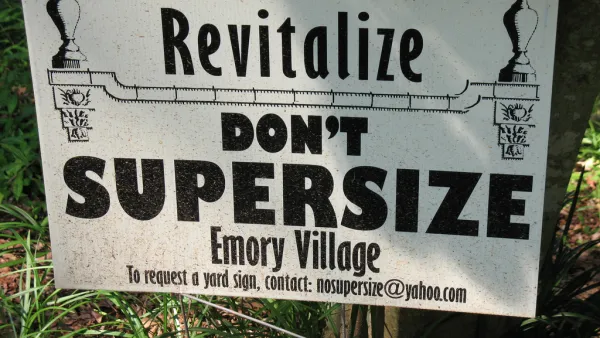
Economic Growth without the McMansions—Is America Ready?
Henry Grabar beckons the death of the McMansion, calling it an "American embarrassment" with no easy solution for planners.

Study Finds Evidence of 'Nationwide Gentrification'
A new study finds that economic inequality is a national problem, evidenced by the access of college educated residents to quality of life indicators in cities all over the country—not just San Francisco, New York, and Boston.
Mayors Drop Cap and Trade from New Climate Agreement
The U.S. Conference of Mayors signed a voluntary agreement to reduce carbon emissions in their respective cities, as they did ten years ago, but dropped the provision that they lobby Congress to pass a cap and trade bill to reduce emissions.
Congress Progressing with Stopgap Transportation Funding Bill
Patch bills advanced in the Senate and the House on Thursday that would keep the Highway Trust Fund solvent through May 2015—good news for state DOTs that will see reduced federal reimbursements on August 1 unless a funding bill is passed soon.
'The Way Forward': What Would Expanded Public-Private Partnerships Look Like?
Robert Puentes and Bruce Katz call for expanded partnerships to build the infrastructure of the future. These new partnerships will require customization by sector and the development of new models for revenue and risk sharing.
Asians and Latinos: Contrasts in Population Growth
The immigration trends in the United States are both changing quickly and a long time in the making, according to new research by the Pew Research Center
Despite Woes, Bike Share Programs Continue to Spread
Bike share programs are spreading throughout the United States, now in 36 urban areas, up from six four years ago. However, half the programs have encountered technical or financial difficulties, according to a tally by The Wall Street Journal.
Friday Eye Candy: USGS Launches Historical Topographic Map Explorer
A new tool, released in partnership with the U.S. Geological Survey and Esri, provides easy access to historical maps from all over the country, featuring a timeline to easily select maps from different eras.

A Conservative Argument for Conservatives to Support New Urbanism
A prominent conservative blogger cites James Howard Kunstler, Edmund Burke, and Joan Didion in making the case for New Urbanist ideals of place, despite the stigma in conservative circles.
Study: Job-Poaching Tax Incentives Do More Harm than Good
Nathan Jensen, a political science professor at Washington University in St. Louis, has found evidence that one of the most popular strategies for state and local leaders to attract new business does not pay off.
Building 'Mixed-Use Industrial' to Spur Economic Development
Ilana Preuss writes for Smart Growth America about the opportunity to integrate small-scale industrial uses into development—what's called mixed-use industrial real estate.
Innovative Transportation Systems Require Innovative Transit Oriented Developments
As new transportation systems continue to emerge and gain popularity, the sacred cows of land use and transportation planning require radical new thinking, according to Gabe Klein.
Women Bikers Ride to 'Take Back the Streets'
Even Andrews reports on the unsafe environment that women encounter while on their bikes—and the organizations and people who are working to make the roads safer from harassment.
House Republicans Announce Transportation Funding Plan
A $10.7 billion funding plan to continue federal transportation spending at the current rate through May 2015 has been offered by Republicans in the House Ways and Means Committee. The General Funds transfer would be offset by "pension smoothing."

FREE Course: Walkable City 1: Why Walkability?
After describing his path towards focusing on walkability as the essence of good planning, Jeff Speck marches through his five principal reasons for making more walkable places.
Reinventing Malls: Planning Alchemy—Turning Gray Fields Into Gold
The course focuses on the opportunities and imperatives that shape reinvention of mall sites.

One Hundred Miles
County of Mendocino
planning NEXT
The Architects Foundation
University of Cincinnati Online
Montrose County
Northern Illinois Transit Authority (NITA)
The Pocatello Development Authority









