For the first time since 2011, Congressional negotiators have agreed on a $1.012 trillion omnibus budget bill to fund the federal government. Tanya Snyder examines the Transportation, Housing and Urban Development winners and losers.



Though the Transportation, Housing and Urban Development (THUD) portion of the bill saw a 2 percent decrease in overall spending levels, "[t]he results for multi-modal transportation programs [PDF] are better than we’ve grown accustomed to," observes Snyder.
The popular Transportation Investment Generating Economic Recovery (TIGER) program sees its funding increased 20 percent, from $500 million in 2013 to $600 million in 2014. And while Amtrak gets a small boost in funding from last year to $1.39 billion, high-speed rail and the Office of Sustainable Communities and its Integrated Planning and Investment Grants (formerly known as Regional Planning and Community Challenge grants) will receive no funding.
Also of interest to planners: the House Appropriations Committee's summary [PDF] notes that "The bill contains $6.6 billion for Community Planning and Development programs – a cut of $145 million below last year’s level. The Community Development Block Grant formula program is funded at slightly over $3 billion, $82 million above the fiscal year 2013 enacted level."
Read the full story: TIGER Funding Gets 20 Percent Boost in Final 2014 Spending Bill

Trump Threatens Government Shutdown if Congress Funds Amtrak Gateway Tunnel
Trump's animus towards using federal funds to replace a century-old, hurricane-damaged rail tunnel under the Hudson River is so strong that he warned Congress he will veto a spending bill they must pass by March 23 to keep the government operating.

Analysis: ROAD to Housing Act could take years to implement
HUD is tasked with implementing nine new rules as part of the ROAD to Housing Act — while operating with a significantly reduced staff.
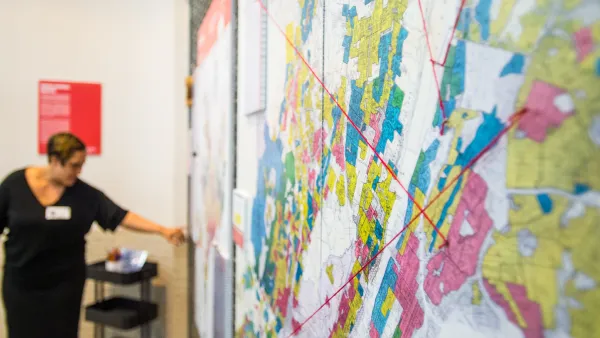
How HUD is dismantling fair housing enforcement
Fair housing law has never been easy to enforce. But HUD's proposal to eliminate the use of disparate impact analysis will remove another crucial tool for doing so.

Planetizen Federal Action Tracker
A weekly monitor of how Trump’s orders and actions are impacting planners and planning in America.

California plans to bury El Niño’s downpour
If the state plays its cards right, it may be able to store a billion acre-feet of El Niño’s water in aquifers.

Desperate measures: Advocates weigh draining Lake Powell to fill Colorado River
Draining the reservoir could reduce evaporation losses by a couple hundred thousand acre-feet.

Housing is the top priority of Seattle’s sole new councilmember
Jenks campaigned on building 1,000 new units of affordable housing.

New tax cuts may slash $1.5 billion in funding for Miami transit, public parks
Amendment 3 will save Miami-Dade homeowners $2,700 in 2028.

Arizona, Wisconsin, Pennsylvania hope to finally advance climate goals post-midterms
The three states have spent years under Republican or divided control.

FREE Course: Walkable City 1: Why Walkability?
After describing his path towards focusing on walkability as the essence of good planning, Jeff Speck marches through his five principal reasons for making more walkable places.
Reinventing Malls: Planning Alchemy—Turning Gray Fields Into Gold
The course focuses on the opportunities and imperatives that shape reinvention of mall sites.

City of Rosemead
Rutgers University, Edward J. Bloustein School of Planning and Public Policy
One Hundred Miles
University of Michigan School for Environment and Sustainability (SEAS)
Hunter College, City University of New York (CUNY)
The Architects Foundation
City of Cambridge
Montrose County
The Pocatello Development Authority