Families

“Multi-gen Floor Plans” and More: How Builders are Responding to the Multigenerational Housing Boom
After a decade-long decline, more Americans are living with parents, grandparents, and extended family, calling for new home designs and living arrangements.

The Natalist Case For Sprawl (And Why It Fails)
Some commentators defend anti-urban government policies such as exclusionary zoning on the basis that homeowning suburbanites have high birth rates. But this doesn't seem to be true in recent decades.

How Urban Design Can Benefit Parents and Kids
Designing thoughtful, child-friendly public spaces can ease the burdens of modern parenting and offer safe spaces for children to learn self-reliance and resilience.

How Courtyard Apartments Make Cities More Family-Friendly
Apartment buildings with interior courtyards can offer safe, affordable, and functional spaces for urban households with children.
Family-Sized Apartments Harder to Find in Dense Neighborhoods
For households looking for three bedrooms or more, finding rental units in walkable places is harder than ever.

In Most U.S. Cities, Archaic Laws Limit Roommate Living
Critics argue laws preventing unrelated adults from living in the same home fail to understand the modern American household.

Kids and Urbanization
The question of whether there is space for children in rapidly changing cities was under investigation in two recent studies with somewhat contradictory findings.
Op-Ed: Zoning Shouldn't Discriminate Based on the Definition of 'Family'
By designating that "family" refer to a specific set of ties, many zoning codes make it difficult for "functional" families without those ties to find a place to live.

Where the Children Are
Richard Florida counters the idea that children and families are disappearing from U.S. cities.

Philadelphia Rowhouse Owners Embrace the 'Overbuild'
Quarters can be cramped for growing families in Philadelphia's many two-story rowhouses. Rather than decamp to the suburbs, more and more homeowners are simply adding a third story, known as an "overbuild."

Family-Unfriendly Housing in Washington D.C.
As new construction favors single occupants and childless professionals, the capital's housing stock is increasingly boxing out families.

More Young Americans Living With Their Parents Than Any Year Since 1940
The highest share of young Americans living with their parents hit a record high of 40.9 percent in 1940. In 2016, the share falls just short of that figure, at 40 percent.
Families Departing Philadelphia for the Suburbs
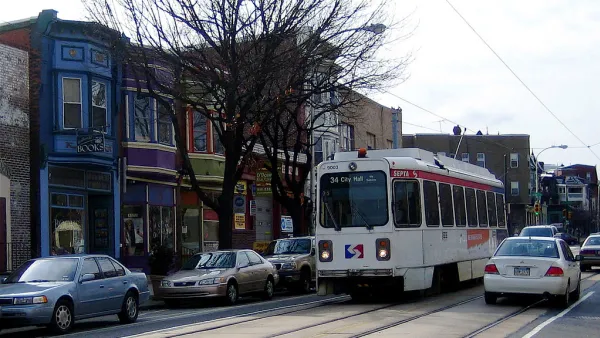
That headlining claim is found in a recent research study from Pew Charitable Trust's Philadelphia Research Initiative—more demographic goodies are included.

Are Families Important in the 'New City'?
U.S. cities leave a lot to be desired for raising a family. However, is it really a worthwhile goal to make cities family friendly? Marin Gertler, a San Diego architect ponders the question after a recent visit to New York City.
Op-Ed: Jane Jacobs Wouldn't Recognize the Cities of Today
Without children at the center of activity, the urban neighborhoods of today offer little compared to the ideals expressed by Jane Jacobs, according to this strongly worded critique of contemporary urbanism.

City vs. Suburb Battle Reignites
There's a new volley in the long-running battle between cities and suburbs. In his new book "The Human City," urban scholar Joel Kotkin contends that cities and their planners have lost sight of the residents who matter most: families.
The U.S. Cities With the Most Children
Governing magazine digs into the data about which cities American families are more likely to call home.

The Popsicle Test: What Makes a City Good for Children?
Low crime rates and affordable property preoccupy adults, but kids need something more: the ability to walk the streets and play out on their own. In The Guardian, Viv Groskop explores the "popsicle test" and other elements of child-friendly cities.
Cities, the Middle Class, and Children
Joel Kotkin argues that Jane Jacobs's insights are of limited value because cities are no longer useful for middle-class families.

How to Keep Young Families from Fleeing to the Suburbs
Millennials are loving their center cities these days, with their lofts and bars and yoga studios. But what happens when Millennials start to have families and don't quite fit, physically or culturally, into city life anymore?

FREE Course: Walkable City 1: Why Walkability?
After describing his path towards focusing on walkability as the essence of good planning, Jeff Speck marches through his five principal reasons for making more walkable places.
Reinventing Malls: Planning Alchemy—Turning Gray Fields Into Gold
The course focuses on the opportunities and imperatives that shape reinvention of mall sites.

City of Thousand Oaks
City of Wisconsin Rapids
Harvard University Graduate School of Design
The Architects Foundation
University of Cincinnati Online
Northern Illinois Transit Authority (NITA)
The Pocatello Development Authority
The Urban Renewal Agency of the City of Pocatello