Apartment buildings with interior courtyards can offer safe, affordable, and functional spaces for urban households with children.


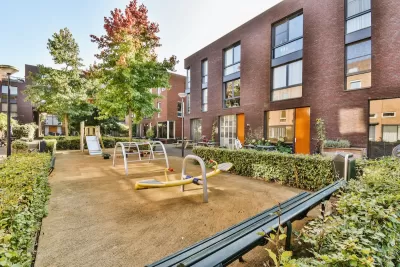
Is there one simple yet impactful design choice that can make urban housing more family-friendly and safe for children? According to Alexandra Lange, the answer is yes: the courtyard apartment building.
As noted by Jenny French of design firm French 2D, “In an urban setting, the barrier that the contemporary parent has to letting their child out the door, thinking about the car-dominated city where they are unable to play in the street – the courtyard is a natural alternative.”
Lange offers examples from around the country, showing how thoughtfully designed courtyard apartments offer a way for children and neighbors to safely play and interact. “For Brunson Terrace, a 48-unit, 100% affordable project which opened in Santa Monica in 2024, Los Angeles architects Brooks + Scarpa left its modest ground-level courtyard to the kids, with bright climbing structures surrounded by organic planting beds. Exterior bridges, stairs and walkways provide access to quieter seating areas. They also make circulation more fun and functional: laundry rooms are located adjacent to the stairs, so caregivers can do chores with an ear out for their kids playing below.”
Courtyards don’t have to belong to the past. While textbook examples in brick and stone are lovely — and still home to thriving communities — contemporary architects are making courts in all sorts of materials, and for all types of housing, from apartments to townhomes.
As Lange points out, “Courtyard housing also offers a powerful salve for the housing affordability crisis. Most courtyard housing is also ‘missing middle housing’ — defined as multifamily projects ranging from accessory dwelling units and duplexes to mid-rise apartment buildings — most of which could easily be arranged around common green space.”
FULL STORY: From Brooklyn to Santa Monica, Courtyards Make Apartments More Kid-Friendly


Planning Communities for Thriving Children
When it comes to children's health and economic success, current trends are dismal. New research identifies how to plan communities where children can thrive. The secret? Compact, mixed-income, multimodal neighborhoods.

Planning Communities for Children and Families
Child in the City asks “If you could see the city from an elevation of 95 cm, what would you do differently?” It provides a toolbox of specific policies and planning practices for creating more child-friendly communities.

How Urban Design Can Benefit Parents and Kids
Designing thoughtful, child-friendly public spaces can ease the burdens of modern parenting and offer safe spaces for children to learn self-reliance and resilience.

The state-sanctioned urbicide of Austin
People don’t kill cities. Freeways do.

US to reduce Colorado River water deliveries to Mexico
A new Colorado Treaty amendment reduces Mexico’s Colorado River water allocation by 250,000 acre feet.

New Jersey’s second-largest city bans standalone data centers
Jersey City will continue to allow co-location facilities, such as those meant for research institutions that store their own data.

Amtrak not solely to blame for New Jersey commuter rail's unreliability, report finds
A new study from the Garden State Initiative found that NJ Transit’s budget grew 20% across a 4 year period, but reliability declined significantly over the same period.

EPA erases limits on planet-warming pollution from power plants
Under Monday’s plan, power plants would still have some limits on how much mercury, arsenic and other contaminants they can emit.

Phoenix announces new on-demand transit service, more frequent RAPID buses
Both new services will launch in October, and are part of Phoenix's Project Effective Access Solutions for Easing Congestion.

FREE Course: Walkable City 1: Why Walkability?
After describing his path towards focusing on walkability as the essence of good planning, Jeff Speck marches through his five principal reasons for making more walkable places.
Reinventing Malls: Planning Alchemy—Turning Gray Fields Into Gold
The course focuses on the opportunities and imperatives that shape reinvention of mall sites.

Eagle County Government
Harvard University Graduate School of Design
Nashville Planning Department
The Architects Foundation
University of Cincinnati Online
The Pocatello Development Authority
The Urban Renewal Agency of the City of Pocatello
Journal of the American Planning Association