The state has less than one-third the funds necessary to build the 800-mile line connecting Northern and Southern California, depending on the cost estimate. The immediate goal is to build a 119-mile section in the Central Valley.


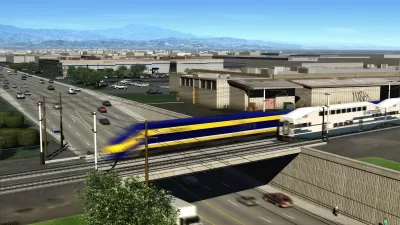
"The high-speed train in California, championed by [Gov. Jerry] Brown, a Democrat, and Arnold Schwarzenegger, his Republican predecessor, is the most ambitious public transportation project underway in the nation today," reports Adam Nagourney, Los Angeles bureau chief of The New York Times. Unlike the privately funded, 240-mile Houston to Dallas Texas Central high-speed rail line, the California High-Speed Rail Authority has not attracted private financing.
"Beginning construction without all of the financing in place represents a strategic gamble by the rail authority, and by Mr. Brown, that once enough work is completed, future leaders will be loath to walk away from the project and leave a landscape of unfinished pillars, viaducts, bridges and track beds," adds Nagourney.
Faced with reduced resources, the authority has altered its plans, and is now focused on finishing a 119-mile stretch of track from Bakersfield to Madera by 2022. [See California High-Speed Rail Authority project sections Merced to Fresno and Fresno to Bakersfield].
One problem with that plan is that the state's two main population centers see no evidence of high-speed rail construction, with the possible exception of newly constructed poles along the San Francisco peninsula, financed in part with $600 million from the rail authority, used to electrify the San Francisco-to-San Jose commuter rail line, Caltrain. The regional project is scheduled for completion in 2023, and high-speed rail, traveling along the same corridor, 11 years later.
Backing the Central Valley plan is Brian P. Kelley, who was the first secretary of the California State Transportation Agency (CalSTA), and as of Jan. 17, the Authority's new chief executive officer. With one section operating, "people will rally around the project and the business community would become convinced of its viability," adds Nagourney.
“If I can get trains on the ground, Californians will start to see that this is something that we want,” said Kelly.
“Yes, the project has challenges,” Mr. Kelly said. “And the primary challenge for this same project is the same today as it was the day the voters passed the bond: And that is, we don’t have enough money to build what we want to build.”
"As of now, the rail authority has come up with less than $30 billion of the necessary $100 billion, and the project’s costs are expected to continue to rise," adds Nagourney.
“The rest has to be found,” said Martin Wachs, an emeritus engineering professor at the University of California at Berkeley and a member of a committee appointed by the Legislature to review the project. “At the moment, 100 percent of the cost is going to be absorbed by the taxpayers.”
Cost estimates
On March 12, Adam Brinklow, associated editor of CurbedSF, reported that the Authority's "new draft plan estimates a cost of more than $77 billion (up from the previous overrun estimate of $64 billion) and cautions that the whole thing could get even pricier down the line."
Costs are uncertain and construction could end up either cheaper or more costly than expected, but more costly is likely: The plan sticks to the previously reported low-end estimate of $63.2 billion for the LA-SF corridor but also provides a high-end projection of $98 billion. $77.3 billion is the present “base” estimate. [Also see Tim Sheehan's ariticle in The Fresno Bee on the draft plan's cost estimates.]
Aside from tapping some of the $9.95 billion funding from Proposition 1A, High-Speed Rail Act (2008), the state began providing cap-and-trade auction proceeds to the project, including committing 25 percent of all future revenues annually, according to the Legislative Analyst's Office. As of January 8, 2016, $5 billion of the bond funds had been appropriated, in addition to $3.5 billion in federal funding received under the Obama administration.
Political uncertainty after Brown retires this year
"For all the construction, the project faces the ever-present threat that a future governor may decide that state resources would be better used dealing with, to name one example, the housing crisis," adds Nagourney.
Mr. Brown’s enthusiastic backing has been crucial to the project’s advances. Gavin Newsom, the Democratic lieutenant governor and the leading contender to succeed Mr. Brown, has offered conflicting views of the project over the years; he has at times come close to opposing it outright...By contrast, his Republican opponent, John Cox, has pledged unequivocally to abandon the project if elected.
While the public is split on support for the project, according to a U.S.C./Dornslife/Los Angeles Times poll done in May, support drops considerably when told of cost overruns.
Nagourney goes on to describe more challenges awaiting the project, not the least of which is "tunneling through the Tehachapi Mountains, a barrier between the Central Valley and Los Angeles...which Mr. Kelly said could cost anywhere from $4 billion to $13 billion."
Will the 119-mile "build it now" strategy work?
"The more they can show what they have done, the harder it is to abandon the project,” Mr. Wachs said, but adds that the next governor, at some point, might say, "Let’s not throw more good money after bad.’”
FULL STORY: A $100 Billion Train: The Future of California or a Boondoggle?

Legislature Raises Questions on Draft 2016 California High-Speed Rail Business Plan
Uncertainty as to whether cap-and-trade funding would continue past 2020 and opposition to the initial operating segment leaving out the city of Merced were two issues that arose during a Assembly Transportation Committee hearing of the plan.
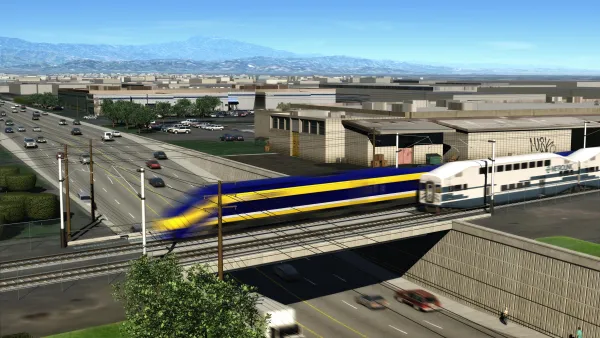
California High-Speed Rail Recommits to Bakersfield-to-Merced Segment
The California High-Speed Rail Authority also certified the Final Environmental Impact Report/Environmental Impact Statement for the San Francisco to San Jose section of the route in August.
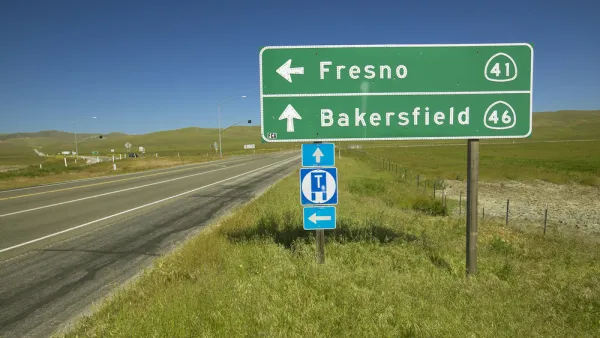
California Governor Envisions Revitalized Cities Along Curtailed Rail Route
California Governor Gavin Newsom dropped a bombshell earlier this week by announcing that California's ambitious high-speed rail project would be pared down. He envisions the Central Valley segment as the spine of a resurgent urban region.

Planetizen Federal Action Tracker
A weekly monitor of how Trump’s orders and actions are impacting planners and planning in America.

The state-sanctioned urbicide of Austin
People don’t kill cities. Freeways do.

US to reduce Colorado River water deliveries to Mexico
A new Colorado Treaty amendment reduces Mexico’s Colorado River water allocation by 250,000 acre feet.

5 New England states march closer to 800 megawatt wind energy project
Securing federal approval for the project may be complicated under the Trump administration, which has historically been hostile towards domestic wind power.

Baltimore to break ground on $50 million Transit Priority Project
The project will bring faster bus trips, safer streets and better bike connections to Baltimore.

Airbnb launches $250 million 'last-dollar financing' housing accelerator, makes first investment in Austin
The company will put $6.4 million towards affordable housing development in Texas’ capital.

FREE Course: Walkable City 1: Why Walkability?
After describing his path towards focusing on walkability as the essence of good planning, Jeff Speck marches through his five principal reasons for making more walkable places.
Reinventing Malls: Planning Alchemy—Turning Gray Fields Into Gold
The course focuses on the opportunities and imperatives that shape reinvention of mall sites.

Eagle County Government
Harvard University Graduate School of Design
Nashville Planning Department
The Architects Foundation
University of Cincinnati Online
The Pocatello Development Authority
The Urban Renewal Agency of the City of Pocatello
Journal of the American Planning Association