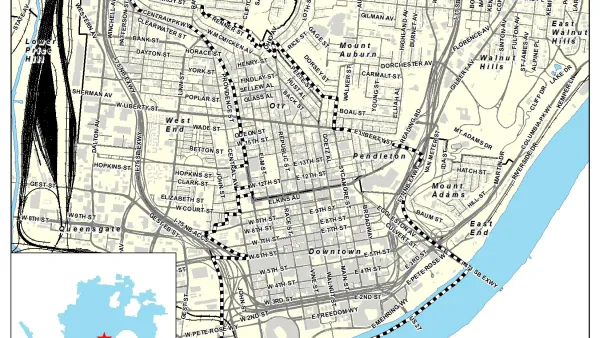
A proposed Urban Parking Overlay District would end requirements for off-street dedicated parking in two of Cincinnati's busiest neighborhoods.



John Young writes on opinion piece offering support and advice for the Cincinnati City Planning Department as it prepares an Urban Parking Overlay District for the downtown and Over-the-Rhine neighborhoods.
"If approved, the district would remove the requirement for uses in downtown to provide off-street dedicated parking," according to Young, and Young is all for ending off-street parking requirements.
According to Young, the city has added thousands of parking spots in the last six years, leaving the downtown neighborhoods with an overabundance of parking. Instead of the status quo, Young encourages a Shoupista-approved approach to parking innovations, and new kinds of infill development that could be attracted to a parking requirement-free development market.
"Even when parking requirements are reduced or eliminated most banks and investors still require parking to be provided or identified for developments to move forward," explains Young to make a key point. "Removing zoning requirements for parking often allows the developer to build the parking that is really needed and not what is arbitrarily demanded by local zoning controls. This reduces the cost of development and in turn, allows more affordable housing to be provided."
Young includes more details about what a post-parking requirement approach to parking might look like in Cincinnati, as well as the kinds of benefits the city could shoot to achieve in implementing parking reform.
Read the full story: EDITORIAL: Parking Requirement Removal Should Be First Step In Broader Reform


Cities Rethinking the Value of Parking
The effort to reclaim public and private spaces from car storage had some setbacks since the days of al fresco and open streets in the first years of Covid-19. But widespread parking reforms and new evidence shows the public is rethinking parking.

Cincinnati Ends Parking Requirements in the City’s West End
The West End neighborhood of Cincinnati is home to 6,000 residents but only one dine-in restaurant.
Downtown Cincinnati: Parking Not Required
The Cincinnati City Council voted this week to eliminate parking requirements in vast swaths of the downtown urban core.

Planetizen Federal Action Tracker
A weekly monitor of how Trump’s orders and actions are impacting planners and planning in America.

California plans to bury El Niño’s downpour
If the state plays its cards right, it may be able to store a billion acre-feet of El Niño’s water in aquifers.

Chicago breaks ground on $3 billion megadevelopment
The new neighborhood, titled Foundry Park, will one day host 3,700 residences.

Satanic Place Names
From streams and lakes to valleys and canyons, I mapped more than 1,000 places named after the Devil.

California High-Speed Rail Authority CEO resigns after $600,000 scandal
Under Ian Choudri, the authority used taxpayer dollars to fund first class flights and trips to nightclubs.

Want to study the Missouri River? Soon, you may need unanimous approval from 10 states
Legislation would require 10 governors’ permission to study or build projects moving water outside the basin.

FREE Course: Walkable City 1: Why Walkability?
After describing his path towards focusing on walkability as the essence of good planning, Jeff Speck marches through his five principal reasons for making more walkable places.
Reinventing Malls: Planning Alchemy—Turning Gray Fields Into Gold
The course focuses on the opportunities and imperatives that shape reinvention of mall sites.

City of Rosemead
Rutgers University, Edward J. Bloustein School of Planning and Public Policy
One Hundred Miles
Hunter College, City University of New York (CUNY)
The Architects Foundation
University of Cincinnati Online
City of Cambridge
Montrose County
The Pocatello Development Authority