At-grade light rail has a hard time safely and efficiently traversing Downtown San Jose on Second Street. A new pilot project will look to improve the situation.


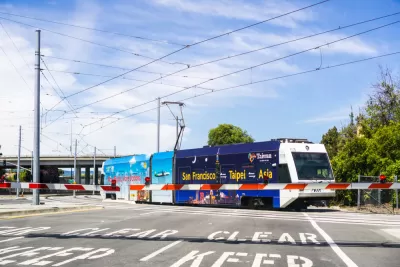
Santa Clara Valley Transportation Authority trains traveling through San Jose have some of the slowest travel speeds of any light rail system in the country. Trolleys travel 7.5 miles per hour in downtown, with a maximum speed of 10 miles per hour.
"Now the Valley Transportation Authority is launching a $900,000, six-month pilot project to speed up the trains and erect barriers to funnel pedestrians, bicyclists and drivers to certain areas for crossing," reports Gary Richards.
The pilot project will take place on Second Street between San Fernando and San Carlos. "The VTA will test railings and street lights to delineate the sidewalk from the track," according to Richards. "The railings will have breaks for driveways and the Paseo de San Antonio crossing. The agency will also include crosswalk improvements and better warning signals for vehicles entering and exiting the Pavilion Garage."
Speeding up the trains aren't the only potential benefit of the pilot project. VTA trains have been in 125 incidents with automobiles, pedestrians, and people in bikes in the past eight years—so the project is expected to improve traffic safety as well.
Read the full story: Slow trains in downtown San Jose may speed up

Light Rail Service Restored in South Bay Area
The Santa Clara Valley Transportation Authority (VTA) will start running trains again today, two weeks after shutting down service.
Financial Woes at Santa Clara Valley Transportation Authority
A $25 million operating deficit will inspire some soul searching, and structural changes.
Silicon Valley's Beleaguered Transit System Getting an Overhaul
Strapped for cash and faced with rapidly declining ridership, the Valley Transportation Authority (VTA) is reorganizing its service in the hopes of stopping the bleeding.

Planetizen Federal Action Tracker
A weekly monitor of how Trump’s orders and actions are impacting planners and planning in America.

California plans to bury El Niño’s downpour
If the state plays its cards right, it may be able to store a billion acre-feet of El Niño’s water in aquifers.

Chicago breaks ground on $3 billion megadevelopment
The new neighborhood, titled Foundry Park, will one day host 3,700 residences.

Satanic Place Names
From streams and lakes to valleys and canyons, I mapped more than 1,000 places named after the Devil.

California High-Speed Rail Authority CEO resigns after $600,000 scandal
Under Ian Choudri, the authority used taxpayer dollars to fund first class flights and trips to nightclubs.

Want to study the Missouri River? Soon, you may need unanimous approval from 10 states
Legislation would require 10 governors’ permission to study or build projects moving water outside the basin.

FREE Course: Walkable City 1: Why Walkability?
After describing his path towards focusing on walkability as the essence of good planning, Jeff Speck marches through his five principal reasons for making more walkable places.
Reinventing Malls: Planning Alchemy—Turning Gray Fields Into Gold
The course focuses on the opportunities and imperatives that shape reinvention of mall sites.

City of Rosemead
Rutgers University, Edward J. Bloustein School of Planning and Public Policy
One Hundred Miles
Hunter College, City University of New York (CUNY)
The Architects Foundation
University of Cincinnati Online
City of Cambridge
Montrose County
The Pocatello Development Authority