While endeavoring to make an honest account of the motivations for driving, it's important to remember that some people really like to drive.


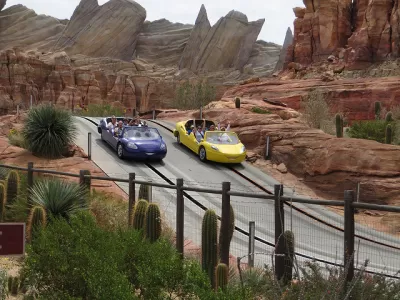
There's an omnipresent Audi commercial where the protagonist "David," obviously living in the future, waxes nostalgic with an A.I. named "Clara" about how driving used to be, before self-driving cars. "Driving wasn't just about being taken from place to place, but going somewhere—feeling something along the way."
Perhaps what David is talking about is the "Joy of Driving," which is far more prevalent a driver of, um, driving than might always be represented in the public discussion about transportation.
Jenna Fortunati, writing for Mobility Lab, has gathered a collection of research on the subject, noting first that researchers acknowledge three motives for driving: instrumental, affective, and symbolic. Fortunati explains the work of a team of researchers at the University of Groningen, who surveyed car commuters in Rotterdam about their motivations for driving—along the lines of the three kinds of motivations mentioned above.
“People more often commute by car when they judge its symbolic and affective functions more favorably,” Steg writes. “Even commuter traffic, which may be considered highly functional, is most strongly-related to non-instrumental motives.”
Other researchers have found similar evidence of driving for the joy in driving. Another study describes the feeling of "carcooning," or turning your car into a relaxation zone.
Fortunati makes no secret that Mobility Lab's interest in understanding these motivations is to provide alternatives to driving, writing: "So how can transit agencies compete? I’m not sure. But understanding this is important, because if we don’t understand why people might like to drive, we can’t reduce the amount of cars on the road – and create a transportation network that is sustainable and works for everyone, not just drivers."
And to make sure the lesson about the joy of driving sticks, here's another paean to cars and driving for the road, from the move Rush (2013).
Read the full story: How much does the “joy of driving” affect people’s decision to drive?

Trump’s Backlash to EVs Is Making All Cars More Expensive — Including Ones that use Gas
Uncertainty about vehicle standards and anti-renewable energy policies are raising the cost of both buying and maintaining a car.
Car Loan Defaults Have Spiked 50%. With Repossession Rates Rising, How Will Americans Get to Work?
In 2024, 1.7 million cars were repossessed in the United States, the highest number since 2009.

Car Trips are Down, With Young People Leading the Charge
Americans are driving less, and we have Gen Z to thank for it.

Planetizen Federal Action Tracker
A weekly monitor of how Trump’s orders and actions are impacting planners and planning in America.

‘Going backwards:’ Baltimore mayor, students rally against state's transit funding plan
Maryland's proposed six-year plan provides no funding for Baltimore’s BMORE bus program and reduces its road maintenance funding.

Detroit to transform waterfront with $2.2 billion investment
Developers will convert about 18 acres of unused parking lot space into civic spaces.

HUD, USDA agree on framework to simplify housing environmental review standards
Their agreement is a requirement of the 21st Century ROAD to Housing Act.

Cost of water rising at a faster pace than inflation, median household income
California and Maryland residents have seen their water bills grow especially high.

NYC building owners overwhelmingly comply with new emissions limits
The New York City Department of Buildings is fining owners who did not file emissions reports.

FREE Course: Walkable City 1: Why Walkability?
After describing his path towards focusing on walkability as the essence of good planning, Jeff Speck marches through his five principal reasons for making more walkable places.
Reinventing Malls: Planning Alchemy—Turning Gray Fields Into Gold
The course focuses on the opportunities and imperatives that shape reinvention of mall sites.

City of Thousand Oaks
City of Wisconsin Rapids
Harvard University Graduate School of Design
The Architects Foundation
University of Cincinnati Online
Northern Illinois Transit Authority (NITA)
The Pocatello Development Authority
The Urban Renewal Agency of the City of Pocatello