A columnist in Austin is reminded of the early days of ride hailing companies. How did that work out for taxis?



Austin American-Statesman columnist Ben Wear writes on the rapid rise of of "dockless scooters" in Austin, where discussion about the trendy and controversial new form of mobility recently hijacked a "dockless bike share community forum" in the city. The city is in the process of creating a dockless bike pilot program in the hopes of regulating the proliferation of private companies thata have spread in other cities.
Like it or not, writes Wear, the city has had to suddenly shift its focus to the electric scooters leading up to this pilot. "About 50 black-and-white electric scooters belonging to Bird Rides Inc., a 7-month-old California company, suddenly showed in South Congress, Zilker and the East Austin entertainment district. City officials scrambled to talk with the company’s representatives, and then said they will impound any of the scooters that sit in city right of way for two days or more."
"However, the city Transportation Department also quickly decided to add scooters to its pilot discussion," writes Wear. "Call this one a draw."
Electric scooters are just the latest in a series of business and technology innovations that threaten to render municipally owned bikeshare companies, in Ausin's case B-cycle, obsolete or ineffective.
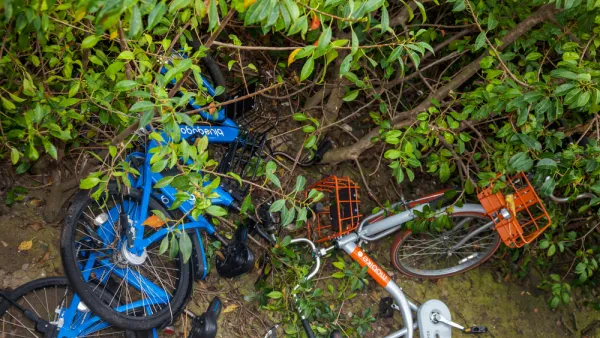
Starting sometime this summer, after the city kicks off a dockless bike (and scooter) pilot authorized earlier this year by the Austin City Council, B-cycle’s 500 or so bikes will soon be outnumbered about 5-1 by LimeBikes, Ofos, MoBikes, Jumps and V Bikes, just to name a few — and, it appears, some scooters as well. And they will be much cheaper to rent than a B-cycle, which carries a $12 charge upfront for the first hour, plus $4 for each 30 minutes beyond that time.
Part of the appeal of the dockless scooter, Wear notes, is the electric assist feature. The B-cycle bikes still require all the pedal power one can muster.
Read the full story: Wear: City girds for bevy of bike rental companies

Transit, Bikeshare Integration Planned in Austin
Under a plan scheduled for implementation later this year, a transit pass will mean access to the city's bikeshare system.
Smaller Cities Rejecting Dockless Bike Share
Two cities, of similar size (about 90,000 residents), and located in different corners of the country, unceremoniously dispatched dockless bikeshare pilots in recent weeks.

Uber Launches Jump Electric Bike Share in Austin
Austin is one of the first cities where users can use Uber's new bike share system, after the transportation network company branched out earlier this year.

Planetizen Federal Action Tracker
A weekly monitor of how Trump’s orders and actions are impacting planners and planning in America.

California plans to bury El Niño’s downpour
If the state plays its cards right, it may be able to store a billion acre-feet of El Niño’s water in aquifers.

Desperate measures: Advocates weigh draining Lake Powell to fill Colorado River
Draining the reservoir could reduce evaporation losses by a couple hundred thousand acre-feet.

In Texas, data centers are swallowing promised parkland
Residents who moved to Taylor, Texas for a rural community now have to contend with three data centers in their backyard.

How a Chicago-sized wind farm beat the odds and powered on
The project spanned five presidential administrations and a standoff with a U.S. military base.

MTA gives itself 30 days to transform pit into basketball court
The site has been under construction since 2022; the city originally estimated it would finish the court in 2024.

FREE Course: Walkable City 1: Why Walkability?
After describing his path towards focusing on walkability as the essence of good planning, Jeff Speck marches through his five principal reasons for making more walkable places.
Reinventing Malls: Planning Alchemy—Turning Gray Fields Into Gold
The course focuses on the opportunities and imperatives that shape reinvention of mall sites.

City of Rosemead
Rutgers University, Edward J. Bloustein School of Planning and Public Policy
One Hundred Miles
Hunter College, City University of New York (CUNY)
The Architects Foundation
University of Cincinnati Online
City of Cambridge
Montrose County
The Pocatello Development Authority