A rollback of fuel economy standards carries huge financial consequences for the all-electric vehicle manufacturer that makes over $300 million annually by selling credits to auto manufacturers unable to achieve current fuel economy standards.


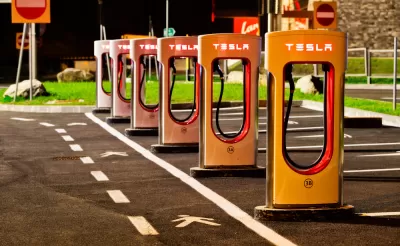
Spring hasn't been good for Tesla: A second fatal crash in Autopilot mode; the largest recall in its history; its bonds are in free fall; a credit-rating downgrade, and falling short of Model 3 production targets.
While the conventional auto industry was delighted with U.S. Environmental Protection Agency Administrator Scott Pruitt's announcement Monday that his agency, working with the National Highway Traffic Safety Administration (NHTSA), a division of the U.S. Department of Transportation, would initiate "rulemaking to set more appropriate greenhouse gas (GHG) emissions standards and corporate average fuel economy (CAFE) standards for cars and light trucks for model years 2022-2025," the news has the potential dire consequences for manufacturers of high fuel-economy vehicles.
"This was the right decision, and we support the Administration .... as it works to finalize future standards," states the April 2 news release from the Alliance of Automobile Manufacturers, the leading advocacy group for the auto industry.
Tesla, which sells only zero-emission vehicles, and not among the dozen auto manufacturers represented by the Alliance, saw Monday's rollback differently.
“Fuel economy standards should be strengthened, not weakened,” Tesla spokeswoman Gina Antonini told Vox's climate and energy reporter, Umair Irfan. “This is overwhelmingly the opinion of the scientific community.”
It's not just science – it's business
The current GHG emissions and CAFE standards, 54.5 mpg by 2025, which translates to "36-38 mpg in real-world terms," enable auto manufacturers which aren't able to achieve the targets to buy credits from those companies who have exceeded them. Tesla is in a class of its own due to its all-electric lineup, though their dominance has created an unexpected challenge for California to meet its aggressive zero-emissions vehicle targets.
"Tesla stands to lose hundreds of millions of dollars annually in three types of lucrative emissions and efficiency credit sales," explains Irfan, if EPA gets its way, which will likely be determined in court due to threatened litigation by California and possibly other states.
According to Tesla’s latest 10-K filing with the Securities and Exchange Commission, the company has seen more and more money coming in from selling these credits. “Revenue from the sale of regulatory credits totaled $360.3 million, $302.3 million and $168.7 million for the years ended December 31, 2017, 2016 and 2015, respectively,” according to the filing.
“They can leverage the same car in multiple categories,” said Benjamin Leard, a research fellow at Resources for the Future.
Weakened fuel efficiency rules "would let companies like Chrysler and GM, which scrape the bottom of average fuel economy rankings, [to] breathe easier," explains Irfan.
That means the weaker regulations will simultaneously help the dirtiest, hurt the cleanest, and derail years of tenuous progress in reducing environmental harm from a growing source of pollution.
The rollback fallout goes beyond Tesla as it will impact the entire electric vehicle industry. Conventional automakers are likely to reduce their investments in clean vehicles if the Trump administration succeeds in reducing emission standards.
Hat tip to Dino Grandoni of The Washington Post.
FULL STORY: The EPA is rolling back fuel efficiency standards

California and Auto Industry Agree on Vehicle Emissions Standards
Normally having the California Air Resources Board and the auto industry in agreement on emissions standards would be enough, but the Trump administration wants to ensure that California plays no role in setting standards.
California and 16 States Sue EPA Over Decision to Rollback Vehicle Emissions Rule
Environmental Protection Agency Administrator Scott Pruitt had announced the rollback of greenhouse gas emission and fuel economy standards on April 2. While the auto industry supports the move, not all auto executives agreed.
Rollback of Fuel Efficiency Standards Announced by EPA
EPA Administrator Scott Pruitt announced Monday that his agency is siding with auto manufacturers and relaxing greenhouse gas emission standards for new cars and light trucks.

Planetizen Federal Action Tracker
A weekly monitor of how Trump’s orders and actions are impacting planners and planning in America.

The state-sanctioned urbicide of Austin
People don’t kill cities. Freeways do.

US to reduce Colorado River water deliveries to Mexico
A new Colorado Treaty amendment reduces Mexico’s Colorado River water allocation by 250,000 acre feet.

Mamdani overhauls NYC's Vision Zero plan with 100 new policy goals
The overhaul aims to reduce traffic deaths and make streets safer for pedestrians, cyclists and drivers through lower speed limits, new safety infrastructure and more.

Amtrak not solely to blame for New Jersey commuter rail's unreliability, report finds
A new study from the Garden State Initiative found that NJ Transit’s budget grew 20% across a 4 year period, but reliability declined significantly over the same period.

EPA erases limits on planet-warming pollution from power plants
Under Monday’s plan, power plants would still have some limits on how much mercury, arsenic and other contaminants they can emit.

FREE Course: Walkable City 1: Why Walkability?
After describing his path towards focusing on walkability as the essence of good planning, Jeff Speck marches through his five principal reasons for making more walkable places.
Reinventing Malls: Planning Alchemy—Turning Gray Fields Into Gold
The course focuses on the opportunities and imperatives that shape reinvention of mall sites.

Eagle County Government
Harvard University Graduate School of Design
Nashville Planning Department
The Architects Foundation
University of Cincinnati Online
The Pocatello Development Authority
The Urban Renewal Agency of the City of Pocatello
Journal of the American Planning Association