Opponents cite environmental risks, supporters hope the facility will boost the economy of a struggling community.


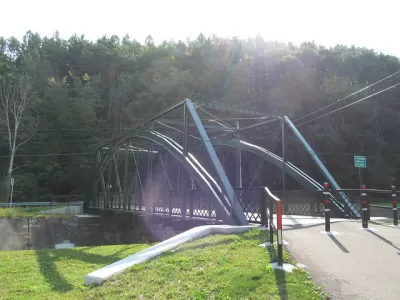
In a sprawling column for the Pittsburg Post-Gazette, Don Hopey reports on the political, cultural and environmental issues surrounding a private company's proposed facility to treat wastewater from fracking operations at an existing sewage treatment plant along the Allegheny River.
"The proposal, which the state Department of Environmental Protection is considering permitting, would allow Epiphany to accept and store truckloads of wastewater — up to 400,000 gallons a day — from shale gas drillers. That water would be injected into a natural gas heated-evaporation and distillation boiler where salts and other chemical contaminants would be removed. Up to 42,000 gallons a day of the remaining water would be piped through the municipal sewage treatment plant, then discharged into the Allegheny River."
Those with serious questions about the project include a typical assortment of conservation organizations, as well as a notable number of government entities including the Pennsylvania Fish & Boat Commission, the New York State DEP, the U.S. Army Corps of Engineers and the U.S. Fish & Wildlife Service.
It's also strongly opposed by the Seneca Nation, whose members have not forgotten the events preceding the construction of the Kinzua Dam, nor have they forgotten that in 1974 their land was "inundated by radioactive waste" from a processing site in West Valley, New York.
Supporters say the fracking operations need somewhere to put wastewater, Hopey writes, and "also note that a more robust drilling presence could help fill the economic hole created when Coudersport-based Adelphia Communications Corp., then the fifth-largest cable company in the U.S., went bankrupt in 2002."
Conflict between the environmental risks and potential economic benefits of fracking have been at the center of the debate across the country. New York State banned fracking, only to have one of its more economically depressed regions threaten to secede.
And though the EPA has determined that fracking can threaten drinking water, it's unlikely the agency will do much about it under the Trump Administration
FULL STORY: At Allegheny River's headwaters, treatment plant for fracking wastewater stirs debate

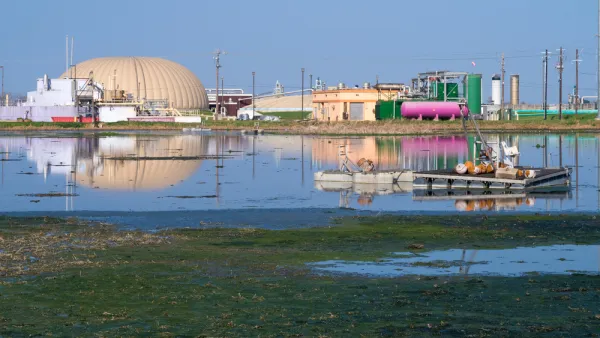
The Sorry State of Environmental Enforcement in Texas
Industry is "routinely violating" clean water laws, but both state and federal regulators seem to be looking the other way.
Comments Closed for Significant Changes to 'Waters of the United States' Rule
The Trump administration has spent the first two years of its time in office trying to overturn key provisions of the "Waters of the United States" rule.
Proposed Water Pollution Rules Await Federal Approval in Washington State
A long and contentious battle, including threats fro the U.S. Environmental protection Agency, could soon find resolution.

Planetizen Federal Action Tracker
A weekly monitor of how Trump’s orders and actions are impacting planners and planning in America.

The state-sanctioned urbicide of Austin
People don’t kill cities. Freeways do.

US to reduce Colorado River water deliveries to Mexico
A new Colorado Treaty amendment reduces Mexico’s Colorado River water allocation by 250,000 acre feet.

5 New England states march closer to 800 megawatt wind energy project
Securing federal approval for the project may be complicated under the Trump administration, which has historically been hostile towards domestic wind power.

Baltimore to break ground on $50 million Transit Priority Project
The project will bring faster bus trips, safer streets and better bike connections to Baltimore.

Airbnb launches $250 million 'last-dollar financing' housing accelerator, makes first investment in Austin
The company will put $6.4 million towards affordable housing development in Texas’ capital.

FREE Course: Walkable City 1: Why Walkability?
After describing his path towards focusing on walkability as the essence of good planning, Jeff Speck marches through his five principal reasons for making more walkable places.
Reinventing Malls: Planning Alchemy—Turning Gray Fields Into Gold
The course focuses on the opportunities and imperatives that shape reinvention of mall sites.

Eagle County Government
Harvard University Graduate School of Design
Nashville Planning Department
The Architects Foundation
University of Cincinnati Online
The Pocatello Development Authority
The Urban Renewal Agency of the City of Pocatello
Journal of the American Planning Association