When the Eagles and the Patriots face off this weekend, they'll do it at Minneapolis' U.S. Bank Stadium, a billion-dollar venue that "aspires to more than football."


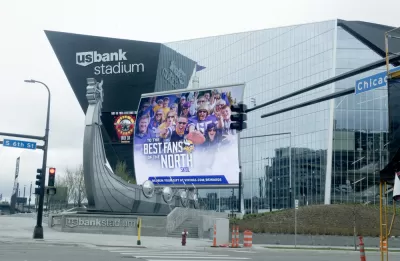
Describing it as "the latest escalation in the luxification of stadium design," Inga Saffron covers Minneapolis' U.S. Bank Stadium, where Super Bowl LII will be held. Forgoing a retractable roof, the venue relies on a partially transparent design. "Fans who have been to U.S. Bank Stadium say they never feel as though they are locked inside a 70,000-seat room. On the southwest side, a soaring glass wall perfectly frames the Minneapolis skyline."
Saffron notes that the venue generates more revenue from business meetings, concerts, and restaurants than from the actual games. "With its sculpted glass carapace, U.S. Bank Stadium has turned the arena into an architectural bauble, a brandable object that aspires to more than football."
The stadium is meant to take advantage of alternative transport modes like light rail, which has been controversially reserved for ticket holders on Super Bowl Sunday. "[Its] design is far more environmentally sound than its predecessors, which were surrounded by acres of parking. Minneapolis' stadium is served by light rail and the city’s 6.5-mile skyway system, which links all the downtown high-rises."
"That network, along with the furnished lounges, carpeted corridors, and fireplaces inside the stadium, increases the sense that the building is a blend of modern building types — airport, hotel, convention center all rolled into one."
FULL STORY: Eagles-Patriots Super Bowl venue is an otherworldly crystal palace

Super Bowl Will Highlight Stadium's Surrounding Urban Development
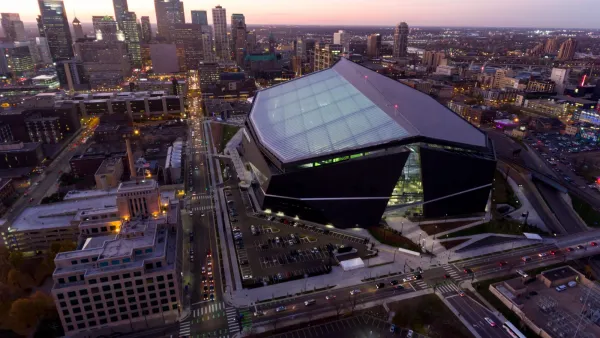
Urbanists and planners might consider looking at the development outside U.S. Bank Stadium in Minneapolis on Super Bowl Sunday. Gone are the vast parking lots surrounding the Metrodome, replaced with mixed use and a popular park, the Commons.
Twin Cities Trains Move to Fewer Cars, Higher Frequency
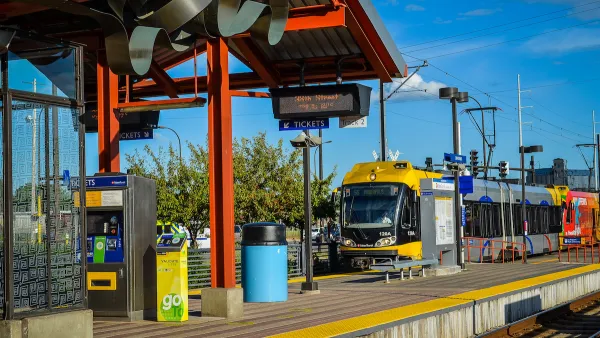
Headways will drop from 15 minutes to 12 minutes.
Washington Commanders Looking to the Periphery for a New Place to Play
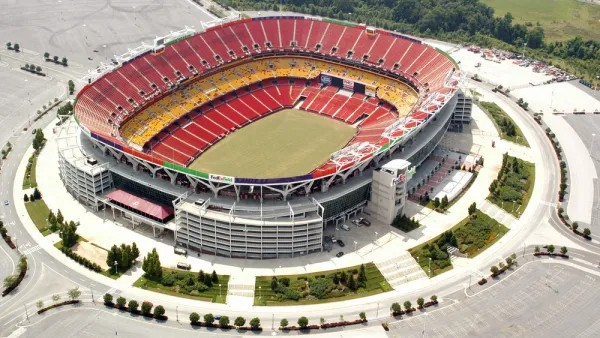
The suburbanization of the National Football League continues.

The state-sanctioned urbicide of Austin
People don’t kill cities. Freeways do.

US to reduce Colorado River water deliveries to Mexico
A new Colorado Treaty amendment reduces Mexico’s Colorado River water allocation by 250,000 acre feet.

New Jersey’s second-largest city bans standalone data centers
Jersey City will continue to allow co-location facilities, such as those meant for research institutions that store their own data.

Amtrak not solely to blame for New Jersey commuter rail's unreliability, report finds
A new study from the Garden State Initiative found that NJ Transit’s budget grew 20% across a 4 year period, but reliability declined significantly over the same period.

EPA erases limits on planet-warming pollution from power plants
Under Monday’s plan, power plants would still have some limits on how much mercury, arsenic and other contaminants they can emit.

Phoenix announces new on-demand transit service, more frequent RAPID buses
Both new services will launch in October, and are part of Phoenix's Project Effective Access Solutions for Easing Congestion.

FREE Course: Walkable City 1: Why Walkability?
After describing his path towards focusing on walkability as the essence of good planning, Jeff Speck marches through his five principal reasons for making more walkable places.
Reinventing Malls: Planning Alchemy—Turning Gray Fields Into Gold
The course focuses on the opportunities and imperatives that shape reinvention of mall sites.

Eagle County Government
Harvard University Graduate School of Design
Nashville Planning Department
The Architects Foundation
University of Cincinnati Online
The Pocatello Development Authority
The Urban Renewal Agency of the City of Pocatello
Journal of the American Planning Association