On some busy blocks, Uber and Lyft drivers have nowhere safe to park. Neither do parcel delivery personnel. Shared use mobility zones could address the problem.


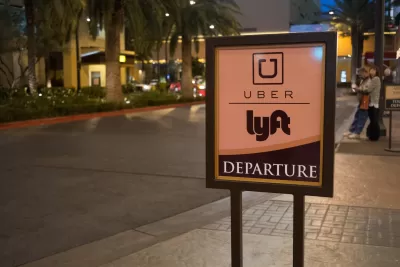
"For nearly a century," Greg Rogers writes, "cities have used curb space designations to serve a set of well-defined purposes: mostly short and long term parking, but also freight deliveries, taxi stands, bus stops, and handicap accessibility." But as urban transport evolves, curb space may also require some tweaks.
In short, says Rogers, "TNCs [transportation network companies like Uber and Lyft] do not have a home on our streets, and freight vehicles do not have enough commercial loading zones and parking places to accommodate booming ecommerce."
Designating short stretches of curb as shared use mobility (SUM) zones, particularly at the beginnings and ends of blocks, could reduce the congestion and safety risks of forcing those drivers to pause amidst traffic.
"Outside of peak hours, these spaces could be converted back to regular parking spaces for consumer vehicles or, where needed, be designated as freight and parcel delivery zones to prevent congestion caused by double-parked trucks." While installing SUMs would mean removing some roadside parking, traffic snarls might also clear.
Read the full story: Ahead of the Curb: The Case for Shared Use Mobility (SUM) Zones

Study: Ride-Sharing Increases Urban Congestion
New research shows that ride sharing contributes to increased congestion and decreased transit ridership.
Study Finds UberPOOL Adds to City Traffic by Competing with the Subway
Past studies have shown how ride hailing services have added to congestion. A new study by Bruce Schaller suggests that even ride shares add to traffic, because they pull riders off of more efficient transit options like public transit.
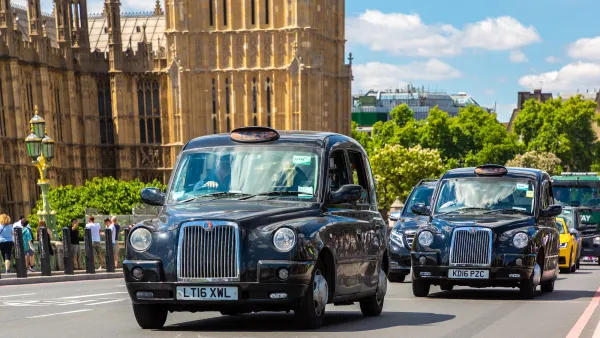
Can Robotaxis Handle London's Famously Tangled Streets?
Black Cab drivers say autonomous cars won’t be able to handle London’s unique conditions.

Planetizen Federal Action Tracker
A weekly monitor of how Trump’s orders and actions are impacting planners and planning in America.

California plans to bury El Niño’s downpour
If the state plays its cards right, it may be able to store a billion acre-feet of El Niño’s water in aquifers.

Desperate measures: Advocates weigh draining Lake Powell to fill Colorado River
Draining the reservoir could reduce evaporation losses by a couple hundred thousand acre-feet.

California city breaks ground on transit connector
The project includes three mobility hubs and a pedestrian bridge.

After public outcry, Massachusetts city releases housing development tracker
Cambridge’s tracker currently shows 250 housing projects in various stages of development.

40 years after approval, Chicago breaks ground on new park
The park honors Jean Baptiste Point du Sable, the city’s first permanent non-native settler.

FREE Course: Walkable City 1: Why Walkability?
After describing his path towards focusing on walkability as the essence of good planning, Jeff Speck marches through his five principal reasons for making more walkable places.
Reinventing Malls: Planning Alchemy—Turning Gray Fields Into Gold
The course focuses on the opportunities and imperatives that shape reinvention of mall sites.

City of Rosemead
Rutgers University, Edward J. Bloustein School of Planning and Public Policy
One Hundred Miles
Hunter College, City University of New York (CUNY)
The Architects Foundation
University of Cincinnati Online
City of Cambridge
Montrose County
The Pocatello Development Authority