Former Washington State Representative Margaret Hurley, aided by Margaret Leonard at the local level, saved the Logan neighborhood in Spokane from a freeway plan that would have razed 600 homes. Now the plan is reborn in another part of town.


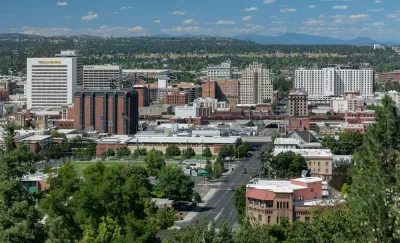
In a two-part feature, Nicholas Deshais reports on an under-appreciated chapter of Spokane, Washington's history: the time the city's female representation in the state and local governments stopped the construction of a north-south freeway through the city.
The main subject of the articles is Margaret Hurley. "Though her name has faded from Spokane’s collective memory since she left elective politics in 1984, her effort is clearly on display on the east side of town."
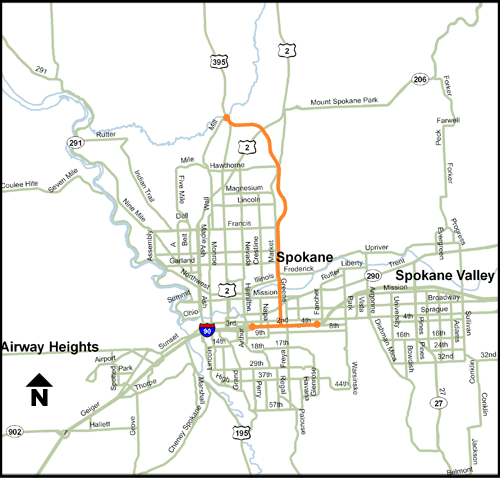
"That’s because the freeway would’ve been built in the 1970s, but Hurley almost single-handedly stopped it," adds Deshais. "Hurley said she opposed the north-south freeway from the beginning because it was proposed to go up the Nevada-Hamilton corridor, blazing a route through the densely populated Logan neighborhood near Gonzaga University."
Among her legislative accomplishments, according to the second article in the series, Hurley "pushed through her law requiring an environmental review of every state highway project."
The law, and Hurley's opposition, saved the original 600 homes in the Logan neighborhood, but the state is again moving forward with the freeway plan, now called the North Spokane Corridor. The freeway is scheduled for completion in 2029, at the cost of $1.5 billion. According to Deshais, "the current route will raze 500 homes and 115 businesses when all’s said and done," by cutting through the neighborhoods of East-Central, Chief Garry and Hillyard.
FULL STORY: Getting There: The woman who fought freeways

Report: Bike Lanes Can't Make up for New Roads
If California wants to meet its climate goals, the state must stop funding its myriad road construction and expansion projects.
Louisiana Freeway Project Faces Civil Rights Investigation
An interstate project decades in the making is being investigated by federal authorities for claims that it would perpetuate historically racist land use patterns.
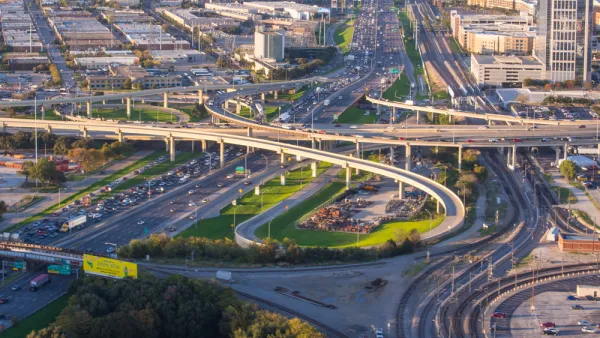
TxDOT Recommends a 10-Lane ‘Infrastructure Grave’ in Dallas
Rather than removing the freeway altogether, which the Texas Department of Transportation calls ‘unfeasible,’ the agency recommends burying the road in a billion-dollar, ten-lane trench through the city’s downtown.

Planetizen Federal Action Tracker
A weekly monitor of how Trump’s orders and actions are impacting planners and planning in America.

The state-sanctioned urbicide of Austin
People don’t kill cities. Freeways do.

US to reduce Colorado River water deliveries to Mexico
A new Colorado Treaty amendment reduces Mexico’s Colorado River water allocation by 250,000 acre feet.

5 New England states march closer to 800 megawatt wind energy project
Securing federal approval for the project may be complicated under the Trump administration, which has historically been hostile towards domestic wind power.

Baltimore to break ground on $50 million Transit Priority Project
The project will bring faster bus trips, safer streets and better bike connections to Baltimore.

Airbnb launches $250 million 'last-dollar financing' housing accelerator, makes first investment in Austin
The company will put $6.4 million towards affordable housing development in Texas’ capital.

FREE Course: Walkable City 1: Why Walkability?
After describing his path towards focusing on walkability as the essence of good planning, Jeff Speck marches through his five principal reasons for making more walkable places.
Reinventing Malls: Planning Alchemy—Turning Gray Fields Into Gold
The course focuses on the opportunities and imperatives that shape reinvention of mall sites.

Eagle County Government
Harvard University Graduate School of Design
Nashville Planning Department
The Architects Foundation
University of Cincinnati Online
The Pocatello Development Authority
The Urban Renewal Agency of the City of Pocatello
Journal of the American Planning Association