But only if you drive a Tesla. Unlike a traditional "fill-up," charging an EV takes time—30 minutes for Tesla Superchargers—so Tesla provides an exclusive lounge for its customers at a new 40-Supercharger "rest stop" on I-5 in California.


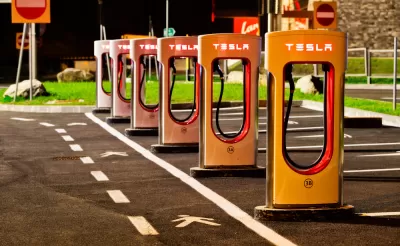
Tesla has taken exclusion to new heights. Not only are their Superchargers proprietary, so are their restrooms.
"[L]ast month, Tesla opened a first-of-its-kind pit stop in California that functions like a cross between a gas station and a members-only lounge at an airport," reports David R. Baker, who covers energy, clean tech, electric vehicles and self-driving cars for the San Francisco Chronicle. "It could be a model for future charging stations — not just for Tesla."
"Tesla’s proprietary network of high-speed Superchargers already included sites along the heavily traveled route" between Northern and Southern California, located at shopping centers and by cafes that aren't necessarily opened 24 hours. And the number of chargers at the stations is limited, which can present a problem "considering that the typical Tesla driver using a Supercharger to replenish the car's battery spends 30 minutes plugged in," adds Baker.
The new rest stop features 40 Superchargers in rows under solar-paneled canopies. More importantly, it includes a 24/7 lounge, accessible only to Tesla drivers and passengers. A code that appears on the cars’ navigation screen unlocks the door.
Inside are plush seats, vending machines, a coffee bar, a play area for children, free Wi-Fi and Tesla T-shirts for sale. And, of course, restrooms.
The pit stop lies just off Interstate 5 in Kettleman City (Kings County), roughly midway between the Bay Area and Los Angeles.
It may be time to retire the term, 'Lexus Lanes," which are available to any solo motorist willing to pay a toll, and in most cases, free to carpoolers, and replace it with a clever moniker for the new Tesla Supercharger stations. [Anyone have a suggestion?]
Hat tip to Paul Scott.
FULL STORY: Tesla’s fancy new I-5 rest stop is part gas station, part airport lounge

Charger Rage Hits Electric Vehicle Country in California
All is not copacetic in the Bay Area's EV community. An apparent shortage of electric vehicle chargers is causing incidents where EV owners disregard proper 'charging etiquette' and unplug the charger from other EVs to charge their own vehicle.

Rivian Joins Movement Toward Universal EV Charging
As more automakers like Tesla, Ford, and Rivian make their charging infrastructure compatible, the shift could lead to the faster development of a nationwide EV charging network.
Will Electric Utilities Disrupt the Oil Industry in California?
A key bill had language allowing public utilities to enter into the electric vehicle charging industry—overlooked by the oil industry and a game-changer for EVs as it tackles one of their most formidable challenges.

Planetizen Federal Action Tracker
A weekly monitor of how Trump’s orders and actions are impacting planners and planning in America.

The state-sanctioned urbicide of Austin
People don’t kill cities. Freeways do.

US to reduce Colorado River water deliveries to Mexico
A new Colorado Treaty amendment reduces Mexico’s Colorado River water allocation by 250,000 acre feet.

Mamdani overhauls NYC's Vision Zero plan with 100 new policy goals
The overhaul aims to reduce traffic deaths and make streets safer for pedestrians, cyclists and drivers through lower speed limits, new safety infrastructure and more.

Amtrak not solely to blame for New Jersey commuter rail's unreliability, report finds
A new study from the Garden State Initiative found that NJ Transit’s budget grew 20% across a 4 year period, but reliability declined significantly over the same period.

EPA erases limits on planet-warming pollution from power plants
Under Monday’s plan, power plants would still have some limits on how much mercury, arsenic and other contaminants they can emit.

FREE Course: Walkable City 1: Why Walkability?
After describing his path towards focusing on walkability as the essence of good planning, Jeff Speck marches through his five principal reasons for making more walkable places.
Reinventing Malls: Planning Alchemy—Turning Gray Fields Into Gold
The course focuses on the opportunities and imperatives that shape reinvention of mall sites.

Eagle County Government
Harvard University Graduate School of Design
Nashville Planning Department
The Architects Foundation
University of Cincinnati Online
The Pocatello Development Authority
The Urban Renewal Agency of the City of Pocatello
Journal of the American Planning Association