A new bike and walking path connecting two cities on the Indiana side of the Ohio River, across from Louisville, could provide a runway for much larger open space ambitions.


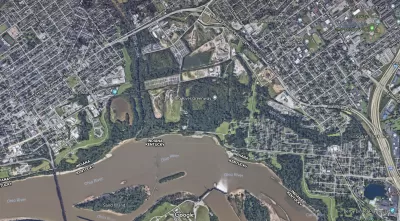
"A new push to transform Southern Indiana's Ohio River Greenway into a world-class urban park builds on a $40-million investment and a decades-old vision of connecting communities through nature and recreation," reports James Bruggers.
"The 7-mile bike and walking path between New Albany and Jeffersonville — linking to Louisville at the Big Four Bridge — is on pace to be completed in 2018," adds Bruggers. "Now, business and open-space advocates are thinking big and charting the next steps, while modeling them after the successful Parklands of Floyds Fork."
A former leader of the Parklands organization has recently created the River Heritage Conservancy, which will spearhead efforts to expand the greenway. The Conservancy has already completed its first land purchase, buying "37 acres of the former Marshall's auto parks on Emery Crossing in Clarksville." According to the article, the multi-jurisdictional span of the greenway will present some of the largest challenges to the project of expanding the greenway.
Read the full story: Indiana launches Ohio River Greenway transformation into a world-class urban park
Parks Endowment Ready to Develop Park-Adjacent Land in Louisville
The Parklands of Floyds Fork has attracted development attention for years, but now the endowment that fought for the park's creation is proposing a development on land adjacent to the park to help fund the maintenance of the Parklands.

Learning loss and urban schools, part 2
Did test scores in progressive cities drop more post-COVID than test scores in moderate ones?
A Historic Investment in LA County’s Parks and Open Spaces
Los Angeles County has launched its largest-ever competitive grant program, investing $58 million to expand park access, enhance climate resilience, and support community-driven projects in the areas that need them most.

Planetizen Federal Action Tracker
A weekly monitor of how Trump’s orders and actions are impacting planners and planning in America.

California plans to bury El Niño’s downpour
If the state plays its cards right, it may be able to store a billion acre-feet of El Niño’s water in aquifers.

Desperate measures: Advocates weigh draining Lake Powell to fill Colorado River
Draining the reservoir could reduce evaporation losses by a couple hundred thousand acre-feet.

Post election, Texas is no longer Musk’s 'AI oasis'
Elon Musk dolled out $446 million on the 2026 midterms, the most ever spent by a non-canidate.

Chicago voters approve permanent festival grounds, penalty for vacant property owners
Currently, major summer and fall festivals take over public parks for weeks at a time, drawing criticism from nearby residents

NYC votes to cut outdoor dining red tape, speed up permitting
New York City also voted to allow the Department of Transportation to begin work on urgent projects before notifying elected officials.

FREE Course: Walkable City 1: Why Walkability?
After describing his path towards focusing on walkability as the essence of good planning, Jeff Speck marches through his five principal reasons for making more walkable places.
Reinventing Malls: Planning Alchemy—Turning Gray Fields Into Gold
The course focuses on the opportunities and imperatives that shape reinvention of mall sites.

City of Rosemead
Rutgers University, Edward J. Bloustein School of Planning and Public Policy
One Hundred Miles
Hunter College, City University of New York (CUNY)
The Architects Foundation
University of Cincinnati Online
City of Cambridge
Montrose County
The Pocatello Development Authority