The agency has created an economic incentive for cities, states and counties to deal with environmental threats.


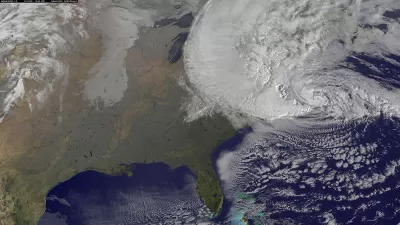
In a new report, Moody’s Investor Services becomes the first of the three major credit-rating agencies to outline how the threat of climate will affect the bond ratings of a given city, county or state.
The company plans to take into account both the actual risk of the effects of climate change—floods, wildfires, rising sea levels, hurricanes—and whether or not appropriate measures have been taken to prepare for those risks.
At NPR, Nathan Rott quotes a Moody’s executive:
"'If you have a place that simply throws up its hands in the face of changes to climate trends, then we have to sort of evaluate it on an ongoing basis to see how that abdication of response actually translates to changes in its credit profile,' says Michael Wertz, a Moody's vice president."
Rott writes that in some places, like South Florida, a fair amount has been done to mitigate potential effects a changing climate, but that “it can be difficult for a policymaker to justify a big investment when the associated benefits or risks seem a long way down the road.”
Significantly, “Moody’s announcement may change that,” Rott writes, effectively created an immediate economic incentive to include climate change preparedness in city and state budgets.
FULL STORY: Credit Rating Agency Issues Warning On Climate Change To Cities

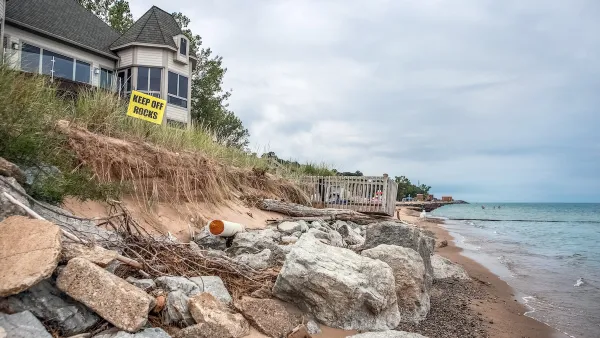
How US Cities Can Prepare for Climate Disasters
Resilience, encompassing infrastructure, governance, economic strength, and social cohesion, is critical for cities to mitigate rising climate risks like flooding, wildfires, and heat, ensuring long-term recovery and adaptability.
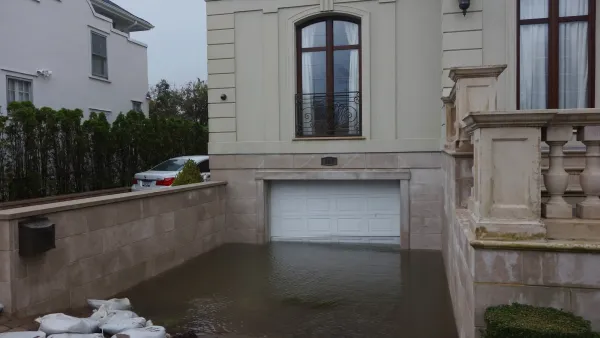
Over 500 NYC ‘Blue Zones’ at Risk of More Destructive Floods
High-risk flood zones cover roughly 20% of the city’s land.
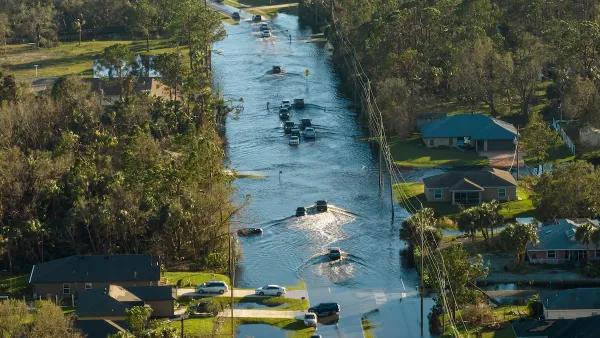
New Florida Law Bars Communities From Planning for Climate, Disaster Resilience
A law aimed at speeding up redevelopment after hurricanes bars “burdensome” land use regulations that could help communities rebuild with more resilience.

Planetizen Federal Action Tracker
A weekly monitor of how Trump’s orders and actions are impacting planners and planning in America.

The state-sanctioned urbicide of Austin
People don’t kill cities. Freeways do.

US to reduce Colorado River water deliveries to Mexico
A new Colorado Treaty amendment reduces Mexico’s Colorado River water allocation by 250,000 acre feet.

Mamdani overhauls NYC's Vision Zero plan with 100 new policy goals
The overhaul aims to reduce traffic deaths and make streets safer for pedestrians, cyclists and drivers through lower speed limits, new safety infrastructure and more.

Amtrak not solely to blame for New Jersey commuter rail's unreliability, report finds
A new study from the Garden State Initiative found that NJ Transit’s budget grew 20% across a 4 year period, but reliability declined significantly over the same period.

EPA erases limits on planet-warming pollution from power plants
Under Monday’s plan, power plants would still have some limits on how much mercury, arsenic and other contaminants they can emit.

FREE Course: Walkable City 1: Why Walkability?
After describing his path towards focusing on walkability as the essence of good planning, Jeff Speck marches through his five principal reasons for making more walkable places.
Reinventing Malls: Planning Alchemy—Turning Gray Fields Into Gold
The course focuses on the opportunities and imperatives that shape reinvention of mall sites.

Eagle County Government
Harvard University Graduate School of Design
Nashville Planning Department
The Architects Foundation
University of Cincinnati Online
The Pocatello Development Authority
The Urban Renewal Agency of the City of Pocatello
Journal of the American Planning Association