[Updated] The Northeast Ohio Areawide Coordinating Agency will provide the funding for two ambitious protected bike lanes in Cleveland.


The Northeast Ohio Areawide Coordinating Agency, a regional transportation planning agency in the Cleveland area, has announced the allocation of $47 million in federal transportation funding to 21 projects, including the city's first protected bike lanes.
Steven Litt reports the details of the funding allocation, focusing especially on the two protected bike lane projects—one called the Midway, "which would extend 2.5 miles along the middle of Superior Avenue from Public Square to East 55th Street," and another called the Lorain Avenue Cycle Track, "which would run along the north side of the avenue between West 20th and West 45th Streets, and the south side from West 45th to West 65th."
Litt provides more detail on the positive reaction the funding garnered in Cleveland, while also pointing to the Indianapolis Cultural Trail as a precedent for the two projects, a comparison he has made before.
[The headline was corrected to reflect the specific amount for the bike lane projects.]
Read the full story: NOACA boosts protected bike lane projects in Cleveland with spending package

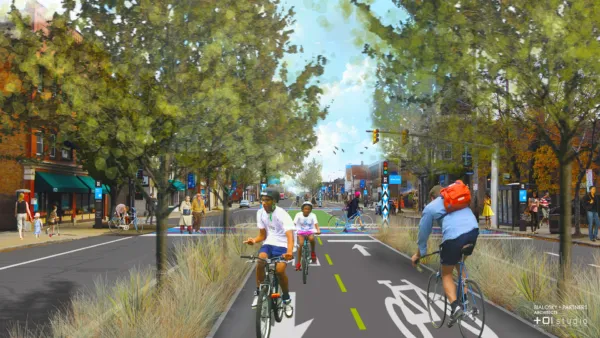
Two Steps Forward, One Step Back for Cleveland Cycle Track Plans
Advocates are thrilled that the city of Cleveland is seeking federal funding for a pair of ambitious cycle track plans—but one of the plans has been significantly watered down.
Equitable Transportation Planning Initiative Advances in Northeast Ohio
The Northeast Ohio Areawide Coordinating Agency (NOACA) is moving forward with a groundbreaking policy to consider regional economic inequities when evaluating potential highway projects.
New Layer of Equity Analysis Considered for Regional Planning in Northeast Ohio
The Northeast Ohio Areawide Coordinating Agency (NOACA) is considering a new policy that will add considerations about regional economic inequities when evaluating potential highway projects.

Planetizen Federal Action Tracker
A weekly monitor of how Trump’s orders and actions are impacting planners and planning in America.

California plans to bury El Niño’s downpour
If the state plays its cards right, it may be able to store a billion acre-feet of El Niño’s water in aquifers.

Desperate measures: Advocates weigh draining Lake Powell to fill Colorado River
Draining the reservoir could reduce evaporation losses by a couple hundred thousand acre-feet.

California city breaks ground on transit connector
The project includes three mobility hubs and a pedestrian bridge.

After public outcry, Massachusetts city releases housing development tracker
Cambridge’s tracker currently shows 250 housing projects in various stages of development.

40 years after approval, Chicago breaks ground on new park
The park honors Jean Baptiste Point du Sable, the city’s first permanent non-native settler.

FREE Course: Walkable City 1: Why Walkability?
After describing his path towards focusing on walkability as the essence of good planning, Jeff Speck marches through his five principal reasons for making more walkable places.
Reinventing Malls: Planning Alchemy—Turning Gray Fields Into Gold
The course focuses on the opportunities and imperatives that shape reinvention of mall sites.


City of Rosemead
Rutgers University, Edward J. Bloustein School of Planning and Public Policy
One Hundred Miles
Hunter College, City University of New York (CUNY)
The Architects Foundation
University of Cincinnati Online
City of Cambridge
Montrose County
The Pocatello Development Authority