A long-awaited draft update of the California Environmental Quality Act (CEQA) has finally been released, and Level of Service will finally be a thing of the past in the next two to four years.



The California Governor’s Office of Planning and Research recently released a large revision of the California Environmental Quality Act (CEQA), including a highly anticipated change from Level of Service (LOS) to Vehicle Miles Traveled (VMT) as the measure of environmental impact. The change was mandated by SB 743, approved in 2013 and covered extensively by Planetizen.
Melanie Curry reports on the big CEQA update as the overhaul will switch gears:
Now that the guidelines [pdf]—including a separate Technical Advisory on the SB 743 changes [pdf]—have been released, the Natural Resources Agency will conduct a formal “rulemaking” process, with more public feedback and discussion, which might bring further changes to the proposed guidelines.
Curry also notes that the guidelines took a painfully long time to deliver, but the "proposed timeline for final implementation is two years from now, in January 2020, according to the Caltrans website."
As for how the rules will take effect in local jurisdictions, Curry explains: "The rules will go into effect as soon as they are adopted, but cities will have two years after that to figure out the switch to the VMT measure." Pasadena, San Francisco, and Oakland [pdf] have already switched to VMT in environmental reviews.
FULL STORY: After 4 Years, Key Rule Requiring Development to Account for New Miles Driven Moves Forward

California Environmental Law Continues to Frustrate Bike Planning (for Now)
Help is on the way. The law that requires the governor's planning office to devise an alternative method for measuring vehicle traffic for environmental compliance will also take up where an earlier law that exempted bike lanes from CEQA left off.
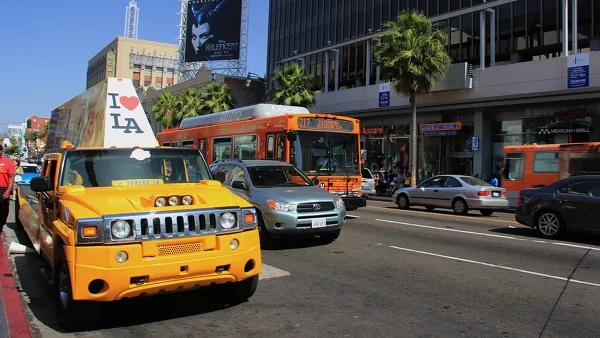
Level of Service Canceled in Los Angeles
The Los Angeles City Council voted to officially end the use of Level of Service in measuring environmental impact in favor of a more people-friendly measure: vehicle miles traveled.
San Francisco Leading CEQA Reform Process—Scraps Level of Service
The San Francisco Planning Commission took historic action earlier this month, voting to end the use of Level of Service in environmental review.

Planetizen Federal Action Tracker
A weekly monitor of how Trump’s orders and actions are impacting planners and planning in America.

The state-sanctioned urbicide of Austin
People don’t kill cities. Freeways do.

US to reduce Colorado River water deliveries to Mexico
A new Colorado Treaty amendment reduces Mexico’s Colorado River water allocation by 250,000 acre feet.

Mamdani overhauls NYC's Vision Zero plan with 100 new policy goals
The overhaul aims to reduce traffic deaths and make streets safer for pedestrians, cyclists and drivers through lower speed limits, new safety infrastructure and more.

Amtrak not solely to blame for New Jersey commuter rail's unreliability, report finds
A new study from the Garden State Initiative found that NJ Transit’s budget grew 20% across a 4 year period, but reliability declined significantly over the same period.

EPA erases limits on planet-warming pollution from power plants
Under Monday’s plan, power plants would still have some limits on how much mercury, arsenic and other contaminants they can emit.

FREE Course: Walkable City 1: Why Walkability?
After describing his path towards focusing on walkability as the essence of good planning, Jeff Speck marches through his five principal reasons for making more walkable places.
Reinventing Malls: Planning Alchemy—Turning Gray Fields Into Gold
The course focuses on the opportunities and imperatives that shape reinvention of mall sites.

Eagle County Government
Harvard University Graduate School of Design
Nashville Planning Department
The Architects Foundation
University of Cincinnati Online
The Pocatello Development Authority
The Urban Renewal Agency of the City of Pocatello
Journal of the American Planning Association