Being able to get groceries without a car can be a big draw in walkable, mixed use neighborhoods. Many Boston grocers and developers are taking that to heart.



For The Boston Globe, Tim Logan reports on a proliferation of ground-level grocery stores in the city's mixed-use neighborhoods. "From the South End to Waltham, builders looking to fill their ground floors with businesses that double as amenities are teaming up with grocers who want easy access to an upscale clientele. The result: A new hybrid, something between the corner grocers of old Boston and the vast supermarkets of suburbia."
Grocery shoppers don't want a long walk, meaning a certain level of residential density must be in place. "For grocery stores, having residents upstairs provides a built-in customer base, and typically one apartment building leads to another, putting more customers within walking distance. They can anchor not just a building, but a neighborhood."
Some developers see ground-level grocery shopping as another amenity to offer prospective residents, and an essential one at that. Still, concerns remain. For instance, "the logistics of loading and unloading groceries in the early morning can be complicated when a few hundred people are sleeping upstairs." And parking is still an issue for those shoppers who do drive in.
FULL STORY: Builders offer a new perk: a very short walk to the grocery store

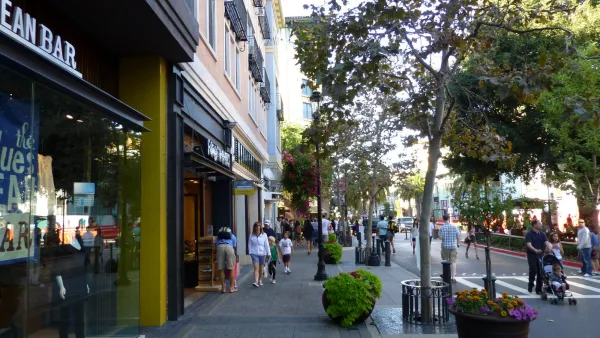
Can Urbanist Islands Make a Difference Where Sprawl Reigns?
The product of a single developer, San Jose's Santana Row is a pocket of urbanism in a sea of sprawl. But can it influence development patterns beyond its bounds, and should it?
Boise Finding Infill Solutions
An article by Sven Borg for the Idaho Statesmen introduces the concept of infill while also detailing some of the challenges facing a wave of development in Downtown Boise.
Survey: Americans want walkable amenities, but not dense housing
While 64% of Americans say they want walkable amenities, only 44% want to see apartments in their neighborhoods.

Planetizen Federal Action Tracker
A weekly monitor of how Trump’s orders and actions are impacting planners and planning in America.

The state-sanctioned urbicide of Austin
People don’t kill cities. Freeways do.

US to reduce Colorado River water deliveries to Mexico
A new Colorado Treaty amendment reduces Mexico’s Colorado River water allocation by 250,000 acre feet.

5 New England states march closer to 800 megawatt wind energy project
Securing federal approval for the project may be complicated under the Trump administration, which has historically been hostile towards domestic wind power.

Baltimore to break ground on $50 million Transit Priority Project
The project will bring faster bus trips, safer streets and better bike connections to Baltimore.

Airbnb launches $250 million 'last-dollar financing' housing accelerator, makes first investment in Austin
The company will put $6.4 million towards affordable housing development in Texas’ capital.

FREE Course: Walkable City 1: Why Walkability?
After describing his path towards focusing on walkability as the essence of good planning, Jeff Speck marches through his five principal reasons for making more walkable places.
Reinventing Malls: Planning Alchemy—Turning Gray Fields Into Gold
The course focuses on the opportunities and imperatives that shape reinvention of mall sites.

Eagle County Government
Harvard University Graduate School of Design
Nashville Planning Department
The Architects Foundation
University of Cincinnati Online
The Pocatello Development Authority
The Urban Renewal Agency of the City of Pocatello
Journal of the American Planning Association