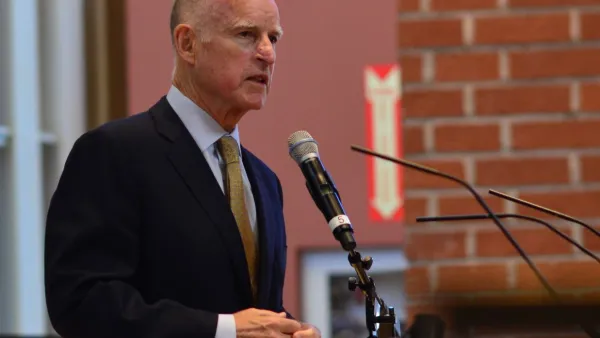
At a new affordable housing project in a low-income neighborhood of San Francisco, Gov. Brown signed the package Friday that places a $4 billion housing bond on the ballot next year, adds a $75 real estate transaction fee, and streamlines permitting.



"The governor signed the legislation surrounded by lawmakers and advocates at Hunters View, a $450-million project that is redeveloping what was once crumbling public housing into new homes for 700 low- and middle-income families," reports Liam Dillon from Bayview-Hunters Point on Friday for the Los Angeles Times. "Speakers at the ceremony hailed the package of bills as a sea change in how the state handles housing issues."
Three senate bills, SB 2, 3, and 35, received the most media attention. Other bills signed previously covered by Planetizen:
- SB 167: Housing Accountability Act, aka anti-NIMBY law, fines cities if they fail to comply with housing law, and SB 166: 'No Net Loss Zoning' bill, limits denial of housing projects. Both are authored by Sen. Nancy Skinner, D-Oakland and were posted here.
- AB 1505 by Assemblymember Richard Bloom (D-Santa Monica) will restore the right to require inclusionary zoning in rental units .
- AB 199 by by Assemblyman Kansen Chu (D-Milpitas) requires previously exempt development to be subject to 'prevailing wage' requirements. [This bill was signed on Sept. 15 and not part of the 15-bill package].
The remaining eight bills are among the 90 bills signed by Brown from Tuesday through Friday listed by Renee Schiavone of Patch:
- SB 540 (Roth) streamlines the environmental review process for certain local affordable housing projects.
- AB 72 (Santiago/Chiu) strengthens the state's ability to enforce laws that require local governments to achieve housing goals.
- AB 73 (Chiu) gives local governments incentives to create housing on infill sites near public transportation.
- AB 571 (E. Garcia) makes it easier to develop farmworker housing by easing qualifications for the Farmworker Housing Tax Credit.
- AB 678 (Bocanegra) increases the standard of proof required for a local government to justify its denial of low- to moderate-income housing development projects. (AB 678 is identical to the aforementioned SB 167, the Housing Accountability Act)
- AB 879 (Grayson) authorizes a study of local fees charged to new residential developments that will also include a proposal to substantially reduce such fees.
- AB 1515 (Daly) allows housing projects to be afforded the protections of the Housing Accountability Act if the project is consistent with local planning rules despite local opposition.
- AB 1521 (Bloom/Chiu) gives experienced housing organizations a first right of refusal to purchase affordable housing developments in order to keep the units affordable.
Hat tip to Gladwyn D' Souza.
FULL STORY: Gov. Brown just signed 15 housing bills. Here's how they're supposed to help the affordability crisis


Critical Housing Bills Pass California Legislature on Final Day
The California legislature ended its season on Friday, handing Gov. Jerry Brown a third major victory. After passing landmark legislation earlier in transportation and climate change, a slate of controversial housing bills await his signature.
California's Housing Bills Fall Short
Three bills at the top of the Democratic leadership's housing agenda will have little impact on the state's chronic housing shortage according to multiple analyses, and wouldn't affect the outcome of a Bay Area mega-development controversy.

Inclusionary Zoning Bill to Increase Affordable Rentals Passes California Assembly
Due to a 2009 court decision, cities and counties in California are prohibited from requiring that a percentage of units in rental developments be affordable. A bill by Assemblyman Richard Bloom would restore inclusionary zoning for rentals.

Planetizen Federal Action Tracker
A weekly monitor of how Trump’s orders and actions are impacting planners and planning in America.

The state-sanctioned urbicide of Austin
People don’t kill cities. Freeways do.

US to reduce Colorado River water deliveries to Mexico
A new Colorado Treaty amendment reduces Mexico’s Colorado River water allocation by 250,000 acre feet.

5 New England states march closer to 800 megawatt wind energy project
Securing federal approval for the project may be complicated under the Trump administration, which has historically been hostile towards domestic wind power.

Baltimore to break ground on $50 million Transit Priority Project
The project will bring faster bus trips, safer streets and better bike connections to Baltimore.

Airbnb launches $250 million 'last-dollar financing' housing accelerator, makes first investment in Austin
The company will put $6.4 million towards affordable housing development in Texas’ capital.

FREE Course: Walkable City 1: Why Walkability?
After describing his path towards focusing on walkability as the essence of good planning, Jeff Speck marches through his five principal reasons for making more walkable places.
Reinventing Malls: Planning Alchemy—Turning Gray Fields Into Gold
The course focuses on the opportunities and imperatives that shape reinvention of mall sites.

Eagle County Government
Harvard University Graduate School of Design
Nashville Planning Department
The Architects Foundation
University of Cincinnati Online
The Pocatello Development Authority
The Urban Renewal Agency of the City of Pocatello
Journal of the American Planning Association