A bus rapid transit proposal is still very much in the planning stages in Milwaukee, with the question of whether the route is allowed dedicated lanes along its entire length is still very much in question.


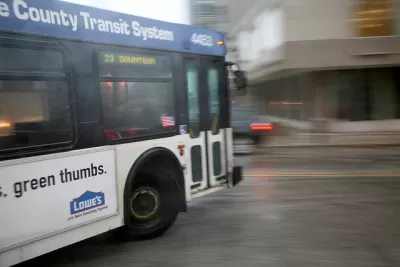
"[T]he Milwaukee Common Council unanimously approved restricting the use of dedicated lanes on a substantial portion of the county’s proposed East-West Bus Rapid Transit line," reports Jeramey Jannene.
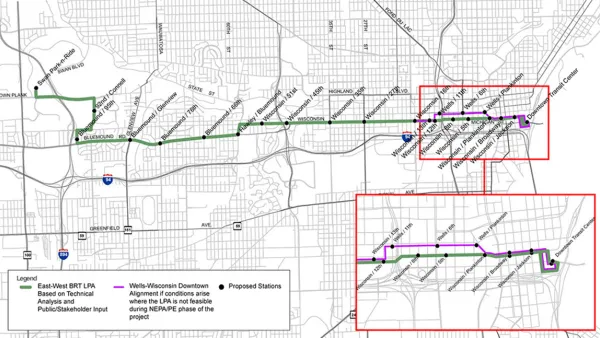
The vote is one sign of discord over the project's planning at the city level. Alderman Robert Bauman, for instance, has criticized the planned route for the line, which would run for nine miles through Wauwatosa and Milwaukee "from a park and ride lot just northwest of the Milwaukee Regional Medical Center to the proposed The Couture tower on on [sic] the lakefront." Jannene allows Ald. Bauman an opportunity to look around the country for examples of BRT projects that Milwaukee should emulate.
Jannene followed up with Ald. Bauman, who is a staunch advocate for public transit, dating back to his earlier career, about other possibilities for the route. Ald. Bauman recommends the new BRT line follows the path of a light rail line proposed in 1996 as part of a failed regional system.
"The BRT project is seeking a grant from the federal government to fund up to 80 percent of its estimated $48 million cost. The project would be operated by the Milwaukee County Transit System," adds Jannene. The article also includes additional links for more background on the project.
Read the full story: Council Approves BRT Route Restrictions
East-West BRT Proposal Finding Little Resistance in Milwaukee
The proposed East-West Bus Rapid Transit project has already built the political support that doomed a previous attempt at light rail along the corridor.
Postponed Milwaukee BRT Project at Least a Decade Away
The county’s transit system won’t pursue a second rapid bus line due to financial constraints.
Milwaukee BRT Proves Popular With Riders
The newly opened line is already reaching pre-pandemic ridership levels.

Planetizen Federal Action Tracker
A weekly monitor of how Trump’s orders and actions are impacting planners and planning in America.

California plans to bury El Niño’s downpour
If the state plays its cards right, it may be able to store a billion acre-feet of El Niño’s water in aquifers.

Desperate measures: Advocates weigh draining Lake Powell to fill Colorado River
Draining the reservoir could reduce evaporation losses by a couple hundred thousand acre-feet.

Los Angeles just elected an urban planner as its mayor
Transportation analysts are optimistic that Raman will be more aggressive in addressing transit issues than Bass.

Mamdani’s pied-à-terre tax survives legal challenge
A panel of judges found that the plaintiffs failed to demonstrate injury as a result of New York City's implementation of the tax.

Eastern Nebraska is running out of electricity
Data centers and electrification are straining eastern Nebraska’s grid, throttling economic development.

FREE Course: Walkable City 1: Why Walkability?
After describing his path towards focusing on walkability as the essence of good planning, Jeff Speck marches through his five principal reasons for making more walkable places.
Reinventing Malls: Planning Alchemy—Turning Gray Fields Into Gold
The course focuses on the opportunities and imperatives that shape reinvention of mall sites.

City of Rosemead
Rutgers University, Edward J. Bloustein School of Planning and Public Policy
One Hundred Miles
University of Michigan School for Environment and Sustainability (SEAS)
Hunter College, City University of New York (CUNY)
The Architects Foundation
City of Cambridge
Montrose County
The Pocatello Development Authority